Friday, 18 January 2013

Slaves to Darkness 25th Anniversary: The Other Realm of Chaos: Bolt Thrower's Album and its Legacy


The classic original cover of Realm of Chaos by Bolt Thrower
The two famous gaming supplements that bear the name, 'Realm of Chaos', are not the only release of the late '88 to do so. Strange as it may seem, a Grindcore/Death Metal Album also shares the name, and much of the imagery. In truth, the album borrowed heavily from both Slaves to Darkness and Rogue Trader, its famous first pressing cover being an extract from John Sibbick's famous cover painting. 


I've mentioned the group and the album before, even going so far as to write an article detailing the rise and fall of the 'Warhammer Records' music label, but I have yet to explore this famous album in any real depth. 

After committing myself to a year long celebration of Slaves to Darkness; its history, miniatures and gaming potential, I was keen to download a digital version of the album to listen to when painting. However, when I shopped on iTunes and bought a new copy, I was puzzled to find that the iconic cover painting had changed but the music was as I remembered. 

Why was this, I thought?

So I found out.

The group took their name from the siege device from Warhammer (as members of the group were keen 2nd Edition players) and Bolt Thrower formed in Birmingham in 1986. The original line-up was a collaboration of Alan West on vocals, guitarist Barry Thomson, bassist Gavin Ward and drummer Andy Whale, who had the intent of making aggressive rock music inspired by bands such as Sacrilege, Discharge and Slayer.


In 1987, Bolt Thrower recorded a demo session, which saw the band reshuffle positions as Ward became a guitarist and Alex Tweedy was brought in as a temporary bassist before Jo-Anne Bench was recruited for their second demo ‘Concession of Pain.’ This caught the ears of Radio 1 DJ John Peel in January 1988 who gave them the opportunity to record a session, which led to the band scoring an album deal with Vinyl Solution Records.


With an album deal under their belt, Bolt Thrower brought in the destructive vocals of Karl Willets for their debut album on Vinyl Solution entitled ‘In The Battle There Is No Law’ before switching to Earache for their second record. 1989’s ‘Realm of Chaos: Slave to Darkness’ was a worldwide success for Bolt Thrower, selling more than 50,000 copies around the world. The band continued their warmongering theme and used expansive artwork from Games Workshop to coincide with their unsympathetic music, with titles such as ‘World Eater’ and ‘Eternal War’.

This worldwide success and critical acclaim propelled Bolt Thrower towards an international audience on the Grindcrusher tour in 1989 with Morbid Angel, Carcass and Napalm Death, before heading out to Holland in 1990 for the Bloodbrothers Tour.

I like music, and my tastes are varied. I enjoy listening to everything from classical, to kitch to contemporary pop and I wondered how the album was viewed by serious metalheads. So I dug around a little and found a review. 


Dan Marsicano: If this was tighter, with cleaner production, and flashy solos, it would be just a generic, soulless album...like what passes for metal today. Bolt Thrower would have none of that, and they didn’t let their new record deal with Earache Records stifle their artillery barrage of sonic annihilation. This is rough, unpolished death metal that relies on the imagery of world destruction, instead of religious bashing or mutilated corpses. Whether it’s a two-minute assault like “Eternal War” or a sneaky backlash of noise like “World Eater,” Bolt Thrower is always in anger mode. Variety is non-existent, with each song sounding like an extension of the previous one. Using a range of tempos does help Realm Of Chaos (Slaves To Darkness) to avoid falling into the trap of not holding a listener’s interest for 12 songs. Realm Of Chaos (Slaves To Darkness) got caught up in the emerging death metal scene during the late ‘80s. Fellow label mates Napalm Death, Carcass, and Morbid Angel were just a couple of the major players that had a part in the genre getting off the ground. What made this album break from the pack was its gritty harshness that didn’t rely on cliches; though the cover art is cartoony, their subject matter was grim and stone-faced. They meant business, and didn’t need gore-drenched imagery to be a fearful sight.

A 'cartoony' piece of cover art eh? Perhaps that was the reason for the change in artwork? Even the grim darkness of the far future wasn't hardcore enough for death metal fans, perhaps? Sadly, this was not the case and a sad (and all too familar) tale unfolded. I'll let Earache, the record label who originally put out the album to explain more.

EarAche: The original sleeve art was the property of Games Workshop, not Earache or Bolt Thrower and when the lease on its use ran out in around 2002 or so, we approached the famous Fantasy wargaming company for a renewal which was flatly refused to us.


This refusal knocked us for six.

So we faced a harsh decision to either discontinue the album, or commission new art by the same artist in a similar style and theme, but being careful to not fall foul of copyright laws. Bolt Thrower themselves were pretty unhelpful by insisting that the original be used in further pressings, but this was impossible as it wasn't ours or their art to use, it was Games Workshops artwork and copyrights. Luckily, we had separately commissioned the actual Bolt Thrower logo, drawn by Mark Craven, so could still use that at least!


John Sibbick drew the original artwork under commission by Games Workshop. Back in the '80s the original edition of the company's biggest fantasy wargame, 'Warhammer 40,000', had this artwork adorning the box cover. Everything about it is copyrighted to the hilt, right up to the design of the weapons, and even the logos on the clothing of the Space Marines fighting in the picture. We obtained the rights to use it after an exceedingly friendly meeting with the managing Director, Bryan Ansell, of Games Workshop, and Andy Jones the general manager. The company was small but growing fast at the time, and being based in Nottingham's Lace Market area, it was a short walk from our office.The guys saw the sense in reaching out to the rock/metal market which Earache and Bolt Thrower offered by using their art on an actual release- and a deal was struck. It was a one page contract/bit of paper saying we had rights to use it lasting 13 years.


An advert for Death Metal and and associated tour in White Dwarf Magazine?  No way you say!
Back in the 80s it did happen though!
By the time of 2002 or so the Games workshop company had become a global billion dollar corporate behemoth. When we asked for a renewal of the artwork rights, it suddenly dawned on us that this wasn't the same local company I met with 13 years beforehand.We were hit with a barrage of legal letters, cease and desist and copyright infringement claims. It was as if the company in its new corporate form had never heard of us, accusing us of theft of their highly prized copyrighted art in the first place. We avoided all contact with GW after that.

So the only solution was to try to track down the artist John Sibbick who had long since left the wargaming art scene, his new career was as a highly respected artist drawing dinosaurs for scientific papers and research. Luckily, when he heard of our dilemma he agreed to kindly redraw similar themed artwork but without any GW copyrighted elements. This is the art used on the new edition from 2004 onwards.


So there it is. The tale of the album and its band. All there is now to do is listen. Who would have thought it, eh? A RPG wargaming supplement with its own (kind of) soundtrack release... It makes me wonder if anything have ever happened like this since!?


THE FULL ALBUM

CONTEMPORARY FULL SHOW FILMED AT ROCK CITY, NOTTINGHAM.IN 1989 - I  WONDER 
HOW MANY GW LEGENDS WERE IN THE AUDIENCE?

Saturday, 12 January 2013

Slaves to Darkness 25th Anniversary: Army of Khorne Audit and Armylist

The raw materials for a retro Khorne Army
Hello one and all... After exploring a little of the history of Slaves to Darkness and life in the GW studio during the Golden Age, thanks to Rick, Andy and Tony, we return to the matter of my anniversary army. Remember that units of Khorne must be fielded in multiples of 8, Khorne' s holy number.

As you can see from the image, I have a fair few models already. I looked at the armylist from RoC and built units based on the models I had available. There are a few models I need but I have here the following;

1 Chaos Champion on Chaos Steed
8 Warriors of Khorne
8 Marauders of Khorne
8 Thugs of Khorne
16 Beastmen of Khorne
4 Chaos Hounds and a packmaster ( I need another packmaster )
Chaos Dwarf Bazooka team
Chaos Dwarf Mortar team ( I need the mortar though )
6 Chaos Dwarfs (I need 2 more dwarfs)
1 Chaos Chariot (not pictured as I am currently working on it)

So only a few models to look out for, though I could easily convert another packmaster and sculpt a mortar, though I would prefer the actual models. Can anyone help here?

Better get painting!

Orlygg.


Friday, 11 January 2013

The Oldhammer Community: Facebook and the Old School

Hello everyone, just a quick update on the nature of 'community'. I have just read Erny's latest post and been inspired to act based on his words. Not so long ago I asked a question about whether Oldhammer was a 'scene' or a 'movement.' Well since then things have changed, haven't they? Forums, new blogs, talk of 'get togethers even T-Shirts!

Having a look at my traffic sources, I am beginning to see 'oldhammer' appearing with greater frequency as interested parties the world over search for more content. I also have seen many similar groups using Facebook to spread the word further, and attract further interest...

So, I have created a Facebook Community Group called, rather unsurprisingly, 'The Oldhammer Community'. I've not been a big user of social media, but after carrying out a number of interviews on the medium, I have discovered its power, especially the WFRP1 Fans group. I've not made the group secret (for obvious reasons) but have ensured that only members have access to each other's posts. I feel that this could be a useful next step in bringing more fans of Old School Citadel etc together and, coupled with the Blood Forums, provide us with more ways to spread our message.

Here's the link, hope to see you there.

Oldhammer Community


Thursday, 10 January 2013

Rick Priestley Interview: From the Realms of Chaos to the Gates of Antares

If music fans had Epstein and the Beatles... Who do we wargamers have as our Svengali?

Well, none other than the Malcolm McLaren of the Rules Mechanic himself; the prolific Rick Priestley! Now, if you've pushed models around a wargames board over the last 25 years or so, then no doubt you've played a game written by, or at least influenced by, Rick.

Effectively (and collectively), we owe him a debt of gratitude for his hand in creating the modern wargames scene. And so to repay his part of this debt, Orlygg dressed up in his chaos armour, took a Rennie to tame his uncontrollable flatulence, mastered his silly walk and terrified the famous games designer into giving an interview for this blog. We discuss life in the GW studio during Bryan Ansell's iconic tenure, Rick's work on WFB3 and RoC and what he has planned for us with The Gates of Antares - which in my view, has the potential to be the most exciting thing to happen to wargaming in 25 years.

Realm of Chaos had a chaotic development cycle that was legendary.

RoC80s: When I approached you about doing this interview, you described beginning work on Lost and the Damned, after a few false starts, rather reluctantly. Does this mean that working on the project was a negative experience for you?

RP: Not quite – the RoC project had been around for a number of years and had passed through various authors and collaborators – none managing to do a job that Games Workshop’s then owner and boss was happy with. So it was something of a poisoned chalice really – with a long list of broken games developers and writers on the casualty list. 

RoC80s: Realm of Chaos is famous for having a very contravolted development; it was first mentioned as a supplement to Warhammer 2 (IIRC) in '83 but didn't rear its head until '88. Why was this? Was it simply studio 'tradition' as Rogue Trader, WFRP etc suffered from a similar treatment?

RP: Yep – like I said – it had been around for a number of years! In fact, I had the first version well underway in 83 and we had a cover and everything – but in the end we decided to push ahead with WH2 instead and RoC had been written for WH1 – so we passed over it until we could get back to the idea. Then other things came up so that didn’t happen for a while! Then 40K was such a success that it was decided that RoC had to have 40K in it as well as fantasy – so that meant writing huge amounts more – so it became a bit of a monster really.

"Anyone fancy a kebab?"
RoC80s: The Lost and the Damned saw you contribute short pieces of narrative fiction. Were staff encouraged to provide these or had they been written for any other purpose? Also, why no further fiction writing from yourself?

RP: Yeah, we all just knocked out the odd bit of text either to fill space where artists hadn’t managed to supply a drawing or to try and capture something of the quality of the world. At the time we had the first version of the Black Library going too, and some of our professional authors were commissioned to write short pieces – and that all helped I think. Actually I’ve written loads of narrative stuff for various projects over the years –we didn’t really think about it at the time – the GW writers in those days were a pretty literate and well-educated bunch – and this at a time when only about 5% of the population were university educated. I mean - we had three archaeology degrees between us! Phil Gallagher could speak Russian and Persian for goodness sake! So turning out short fiction was just part of the job to be honest. 


Dark Future paintball anyone?
RoC80s: There is also much debate about abandoned projects during the period we are discussing. Can you recall any 'almost made its' that never saw the light of day?

RP: Oh let me think… Richard Halliwell had a number of projects about that time which never made it past the finish line. They included an early version of Fantasy Epic, a spaceship game (proto-Battlefield Gothic), and a Doctor Who board game that featured revolving board segments representing different time zones. These segments articulated against each other during play facilitating movement between them – I think the licensing deal fell through on that one. We had a series of board games planned for release in the High Street – these were based on classic games like Snakes and Ladders and had beautiful artwork by Wayne England – I mean the most gorgeous drawings in the style of children’s book illustrations, really jewel like. The two I remember – aside from Snakes and Ladders – were The Great Race Game – vaguely based on an Around the World in 80 Days theme – and a version of Stratego which was to be called Offensive. As the whole series was to be styled ‘Wayne England’s’ such and such – e.g. ‘Wayne England’s Great Race Game’ - I do wonder what Wayne would have made of Wayne England’s Offensive! There was also a mad plan to start a new company that would do live action role-playing (i.e. paint balling) set in the Dark Future world. We all dressed up in Mad Max gear and sloped off to a wood to pot at each other with paint guns. Unfortunately no one thought to mention this to the local constabulary, and when the natives saw the GW crew running round with guns… well. The police were very understanding! 

Just don't mention his dice roll modifiers..!


RoC80s: You've gone on the record (maelstrom interview '11) that you felt that the third edition of Warhammer was the least playable, yet it remains the most fondly remembered. The passion and popularity of this book lies behind our group. In hindsight, do you consider this edition to be a failure in your view of what you (and your colleagues, such as Richard Halliwell etc) had in mind?

RP: No, I don’t see it as a failure at all – and we certainly didn’t at the time. I don’t think that we were at all concerned by the stodgy gameplay and extreme complexity when we produced WH3 and I don’t think anyone else was either – and as you say the passion and energy does come across better in that book than in any subsequent editions of the game. I think that’s right. I just don’t think it’s a very playable game when it comes down to it – the push back movement within the combats is tortuous – the combat resolutions swing wildly because of the double variable ‘to hit’ and ‘to kill’ – which meant that combats could often drop to 2+ followed by 2+ or 6+ followed by 6+. And all those modifiers – modifiers at every stage of the dice roll – to hit, to kill, save… really sluggish stuff! The next edition was way more energetic and actually got people playing Warhammer again (sales had really slumped prior to that). The trouble with the 92 version (4th) was we didn’t have any money because we’d just had the GW management buy out and suddenly we owed the venture capitalists £10M – so there was just no spare cash for anything. We’d gone to an early dtp system, which wasn’t as professional as the old typesetter (but reduced costs as it meant we didn’t need the extra staff), we had fewer artists, and we couldn’t afford the colour (the colour sections were exerted from WD to save money). There were also fewer design staff actually working on the game – pretty much just me with Jervis, Andy and Nigel helping. For 3rd we had half a dozen dedicated writers and another half dozen willing bodies – so we were able to do a lot more. 

RoC80s: Didn't you sculpt the war machine for the goblin chiefs chariot in the early '80s? I am sure I've heard on the scene that it was signed by you good self? If so, did you sculpt anything else in the Citadel range?

RP: I sculpted the spear-chucker  – because I wanted a spear chucker and we didn’t make one at the time – it wasn’t terribly good though I must confess! I did make a few pieces in the early days but mostly straight-line work: treasure chests, weapons, and a range of spaceships some of which survived for years in our general spaceship mix. Before I worked for GW I sculpted for Tabletop Games and Asgard – but it was a long time ago – expectations were not high in those days!

RoC80s: Having interviewed other people involved in GW during this period, they describe the atmosphere in the studio as being very creative and supportive, as well as being very loosely controlled when it came to design. Is this a view that you share?

RP: Erm… well the RoC books extend over such a long development period that the atmosphere in the studio probably went through some changes to be honest. But when we were in Enfield Chambers (prior to 91) the studio was a very easy going creative environment to put it mildly. We were left to our own devices for much of the time, and Bryan Ansell (owner and boss) pretty much kept the creative part of the business separate from the manufacturing and sales part. Bryan was a very creative and ideas driven man – I don’t think he’d mind me saying that – he always wanted to make great games with interesting mechanics and stimulating ideas – and he didn’t mind investing in creative staff. He was a real patron of the studio and took a real interest in all the models and artwork. Bryan always said that if the studio ever had to mix with the manufacturing and sales part of the business it would destroy the studio. And I have to say – he wasn’t wrong there! The modern studio isn’t a studio in the same way; it isn’t a collection of artists and creatives sharing ideas and driving each other on. It’s become the promotions department of a toy company – things move on!

Polystyrene castles anyone?
RoC80s: The other Warhammer third edition supplements, Armies and Siege... Were these planned from the start or originated from elsewhere - like having to sell a polystyrene castle?

RP: I think we’d always wanted to do those things and the castle just provided the opportunity. We didn’t really plan much. We were very reactive in those days, but we were full of ideas so it was always just a case of picking something and going for it.

RoC80s: Right, fast forwards twenty five years... The way you have approached GoA is very novel, involving the players themselves in the design. Has this been something that you have wanted to do for sometime?

RP: I’ve always involved players in games design – it’s just usually those players are my mates or groups I’ve come to know and rely upon for feedback and help. With Antares we’re trying to extend that group via the internet and it just seemed like a good idea to be honest!


RoC80s: The sci fi wargame is a flooded market, both in miniature and software. How can you be sure that what you produce isn't going to be simply more 'generic' space marines/robots with big guns?

RP: Yes I know what you mean – and to some extent you do have to play to the archetypes to make the whole thing work. But we have some very talented sculptors on board and I’m confident we can make something that has a unique flavour and style, even if it recognisably fits into a genre that is perhaps more familiar now than it was back in 87 with Rogue Trader.


RoC80s: Will we see humour? This is something that I feel sets British gaming apart, even in the darkness of Realm of Chaos there were lots of amusing ideas. Will we see this reflected in the background and miniature ranges? (I would love to see a tongue in cheek set of counters that could be cut out, like in the back of RT and WFB3, and played with for play-testing!)

RP: I’d forgotten about the counters! I do try to write in a fairly light style and a certain amount of humour does tend to creep in… where it creeps from I am not too sure! I’m not setting out to write a book stuffed with gags – but we’ll see how it pans out. RoC has some very funny stuff in – often ideas contributed by the team – we had great fun coming up with all the Chaos mutations and many of those came from Bryan himself. We had to tone down the ruder ones!

RoC80s: Will you be taking GoA concepts etc along to any shows this year, such as Salute? I notice that the Alpha version of the rules will be available in April, so are demo games a possibility?

RP: Yes for sure – and we intend to do some club visits too – but a lot depends on where we get to with the kickstarter as that will determine how many of us there will be – if it’s just me I’ll be chained to the desk writing!

Big thanks to Rick for agreeing to this interview... Especially considering he must be up to his neck in his new project. If you are interested in supporting the kickstarter the link is herehttp://www.kickstarter.com/projects/2037958218/beyond-the-gates-of-antares?ref=card, and you can find the GoA website (with some very stimulating forums) here. http://www.darkspacecorp.com/

Enjoy,

Orlygg.

Tuesday, 8 January 2013

An Interview with Andy Craig: Confessions of an 'Eavy Metal Painter!


I want you to think about that first moment you discovered miniature fantasy wargaming. Those first few hours as you sat engrossed, mind open to new and exciting possibilities, creating a wish list in your head...

It might have been D&D, or White Dwarf or even Owl and Weasel, if you are really Old School.

It won't matter!

You would have had 'that thought'.

The thought when you dream that you actually paint and game as a job.

Sadly, for must of us, the thought remained just that, but the subject of Realm of Chaos 80s second interview actually put that thought into reality! He got a job at GW as a figure painter and was at the heart of 'Games Workshop' s Golden Age', working on The Lost and the Damned, the Rogue Trader Ork books and bloodbowl to name just a few...

His name? 

Andy Craig.

Andy's first White Dwarf spread- Eldar Harlequins.
I remember reading of his arrival in the pages of White Dwarf 112. A small note in Culture Shock told me that a new brush was at the studio. You see, the news pages were always my first port of call (I liked to know what was coming out next), while my second was ' Eavy Metal. And there I saw some of his work, the gorgeous harlequins above. There was much debate about this Andy Craig that month on the bus, around the paint station or and elsewhere. So it gives me great pleasure to say that I can present to you a major interview to a fellow painter who ' had the thought' and through his skill and dedication made it his profession.

But that is enough waffle fro me, I'll hand you over to Andy who will tell his remarkable story, supported by many images from his career. Its a personal, and intimate, tale of his time in ' Eavy Metal

Enjoy,

Orlygg.

RoC80s: How did you get into miniature painting and what led you from Lincoln Council to the GW design studio?
AC: I got into miniature painting around 1983. My friend, and still my closest friend to this day, Chris Gent told me about Dungeons & Dragons. I'd always been a fan of all things fantasy; books, art and the like, so we decided to have a game. What caught my eye was the miniatures, in particular ones that were painted to a pretty good standard. I started buying and painting miniatures within weeks. I was shown a copy of White Dwarf showcasing the work of the Godfather of miniature painting, John Blanche. It blew me away and the hooks were in!  Inspiration was high..... I just wanted so badly to be that good. 

It was then I knew this was what I wanted to do as a profession.
So, the first Golden Demon was announced of which I did not enter, as I was no where near good enough. The next year I entered the Golden Demon regional heats 1988 and was placed first. I didn't win in the finals but did get my work ( a cheerleader emerging from a cake ) in the demon year book. The next year I also came first in the regional heats, and it was then that that the Rep from Games Workshop HQ who was judging, suggested I write a letter to Phil Lewis applying for a position at the studio as a miniature painter. I sent the letter and two weeks later got a reply from Phil asking me to go see them in Nottingham. I could not believe my luck and remember well the day of my interview. Can you believe the first person I met on entering the studio was John Blanche himself? 'You the Figure painter?' were his words. The studio (in Enfield ) was like a rabbits warren, we went straight to the figure painters room where Mike McVey, Ivan Bartleet, Darren Mathews and Phil Lewis were busy doing their thing. John and Phil took me into an adjoining room to discuss my work I'd brought along. They had high praise for my painting and offered me a job at the studio right there on the spot, which of course I took. I was given a tour of the studio, met Jes Goodwin, who at the time was working on the Eldar snipers. The Perry twins, Kev Adams, all the game designers; Rick Priestley, Richard Halliwell etc. To say I was shell shocked by what was going on would be an understatement. Started working at the studio two weeks later. The first figure I was given to paint was a Blue Horror, quite difficult to paint but I pulled it off.


RoC80s: How was the studio set up and run? Could you just pick models and get on or were you directed?
AC: Good Question! Like I mentioned above, the studio was like a rabbits warren. It was hard to find your way around for the first few days. The miniature painters room was large enough for six painters and there was a very small room near the back where we primed the miniatures ... We would often emerge from that room feeling very sick due to the spray primer toxins as the extractor was so caked up with paint residue it didn't function properly.
Phil Lewis was the figure painter co-ordinator. He basically gave us the the 'Green- light' as to if the figure was good enough for White Dwarf. Most of the time when we placed a miniature in front of him that blew him away he'd say, jokingly, 'put your hands on the table', we'd say, 'Why?', Phil would say, 'because i'm going to break your hands.....nobody can be that good!'.
There wasn't that much directing as far as painting went and we were given free reign on almost all we painted apart from the obvious Codex conformity regarding Ultra-marines, Space Wolves and Orks etc. I remember been given a brat and a scavvie for the then new and up and coming Necromunda. John Blanche had just completed the cover art for the box which he brought down to me and placed on my desk to use as colour reference. He looked at me and said, 'don' t get any paint on it!'.


RoC80s: What was the working atmosphere like among the 'Eavy metal painters?
AC: Tim Prow sat at a joining table facing myself while Mike, Ivan and Darren were to the other side of us. Tim came to us as an Apprentice aged seventeen, within days he was up to our standard. Of all the miniature painters Tim and I were the closest, always having a laugh. When we were working on Waagghh the Orks, the revamped 40k and all the other Codex (Titans, Eldar etc) the board games....so much stuff, things were not so good. We were painting Orks for what seemed like months. We were asked to create colour schemes for the then new Space Marines which are still used till this day.
Atmosphere for the best part was good. We'd often listen to audio books while we worked; The Lord Of the Rings audio book always went down well when painting Warhammer Fantasy. Every day was Christmas for us, Phil would ask almost every morning 'anything you guys want from the factory', the answer would often be 'Nah'. My desk had a foot deep draw full to the top with miniatures which I sent back to the factory. We were given copies of every figure we painted plus whatever our hearts desired. You have to remember that we too were fans of the miniatures, the difference being we got to see things first hand and probably were as exited as you guys.

My favourite Andy Craig piece, I think - I spent hours trying to paint yellow like this back in the '80s. Andy has said that this was intended to be his next entry to the Golden Demons, but he got the job at the studio before the competition.
RoC80s: You mention lots of the other famous '80s figure painters, what about Colin Dixon, Sid, Steve Mussuard, Pete Taylor, Richard Wright and Steve Blunt. Did you work closely with any of these legends? 

AC: Sid had left by the time I'd started work at the studio, Colin was a figure designer and a really good guy. I was chatting to him one day in his studio at the top of the building, when all of a sudden there was blood all over his work top, he was cutting a slice of green stuff, thumb down on the blade, sharp side up! I think we all looked forward to seeing Steve Mussuard whenever he visited the studio, lovely guy, very funny, unique style, always gloss finished his figures but he used most of his work for gaming. Pete Taylor? OK, I met Pete many, many times, and still to this day I'm scratching my head as to the speed and high standard this guy could paint. Richard Wright didn't paint that many figures but when he did they were off the planet......outstanding, he applied the paint in an almost ink form, very hard to do and a very long process. Mike Beard came to work with us as a kind of holiday, one of the greatest diorama modellers there has ever been, awesome painter to boot and a very dear friend. Fraser Gray, who I would say is in my view the greatest figure painter of all time (just my opinion) was also a regular visitor. The fact he used enamels and white spirit to blend while most of us used saliva! This was very tricky to apply but it didn't seem to phase him. I'm very lucky to be the owner of one of his orks, I think it was in the first Golden Demon year book, an Ork with just a loin cloth holding an axe above its head. He exchanged it for one of my figures although he didn't get the initial figure he wanted, which was my pink 'Kinky Chaosette', so settled for an Amazon limited edition I painted for him. 


RoC80s: When working on technique, how did the team influence and support each other? Was there any other particular painter or painters who supported/inspired you?

AC: Well, for me John Blanche was my biggest inspiration, as with many figure painters. He pushed the boundries and laid the foundations for what exists now. Just before I left GW, John took me to one side and said 'there's two figure painters I'd have paint figures for me and that's you or Mike (McVey)'. 

I was in tears, for this guy to grace me with such a honour kind of completed me as a figure painter.

Between the rest of the figure painters technique/ideas were always shared. I used to buy pots of Humbrol acrylic matt red paint from a model shop in Lincoln for Mike as it was hard to come by. the only red Mike used and probably still does. We had to be at the top of our game back then, so support for each other was always there.


RoC80s: Where you limited to 'Citadel' only products, ie: the original paint sets (colour, monster, creature, ink etc...) or were other products used too?

AC: Basically, whatever it took for us paint to the highest standard in terms of paint we got elsewhere. We just went down to petty cash, were given the money to buy whatever paint. I hated the Citadel red, awful stuff. And the ink back then wasn't up to much. Most of us used Windsor and Newton ink, but having said that most of the Citadel colour was great.


RoC80s: You attended Games Day as part of the 'Eavy Metal display team, as well as a punter. Any juicy memories of those events?

AC: We were just flooded by people at Games Day, couldn't walk more than ten feet without being stopped and asked to sign something, It was a great feeling. I helped take entries in one year to put in the relevant displays and this guy hands me his entry (a standard bearer) and just as he does it broke, my he was pissed, but lucky for him we fixed it and I think he got silver.

Definitive Orks by Darren Matthews (the red noble) and Andy Craig. From the collection of Bryan Ansell. 
RoC80s: Where did your career take you after you left GW?

AC: Freelance figure painter for a while and now a freelance artist with a few publishing deals under my belt. I had many jobs over the years since then, all art related. Theatre design was good fun. Now live in the country with my wife (Renee) and dog (Sparky).

More of Andy's orks, though the middle model was painted by Tim Prow. From the collection of Bryan Ansell.

RoC80s: Did you actually play any of the GW games back in the 80s, and if so which were your favourites?

AC: Talisman, loved that game. never thought I'd be working on it, Talisman City, Space Hulk, we all got photo copies of the games months before release. 


RoC80s: Still painting miniatures today?

AC: Some times, I moved way up in scale and was mostly painting 1/6 scale models for various companies around the world. and felt natural for me to make that transition. Who knows what the future holds?


Bond, Mulder and Scully. Gorgeous, gorgeous blending... From the collection of Andy Craig.

You'd think that that was a real grey jacket, wouldn't you? Phenomenal painting. From the collection of Andy Craig.
Silent Dawn - one of Andy's more recent, and more traditional, works of art.
RoC80s: Life as an 'Eavy Metal painter in the '80s seems very Rock 'n' Roll at times! Any wild stories to share?

AC: OK! Funny memories and one in particular; the studio toilet was on the next level down from us, and for some reason the light switch was outside in the corridor, so Tim and I thought it would be funny to turn the light off when someone went for a shit, the funniest thing is that I forgot to turn the light back on and all I could hear is someone shouting; 'TURN THE FUCKING LIGHT ON!' 

Kev Adams was a really funny guy, often bursting into our room, sitting on a chair and lighting his farts, or painting a figure really badly then putting it in front of Phil for approval. One thing we all loved, and still love, about Phil Lewis is that he was so proud of us all and kept our spirits high.

Brian May of Queen came to meet us with his then young son, the one day I wasn't at work. Phil gave him a painted figure and in return Brian sent him a letter of thanks. The Heavy Metal band Gwar came to meet us in full stage costume, they were big fans of ours. 

I should mention the artists. Tony Ackland, Paul Bonner, Wayne England etc, who were great guys to chat to, you had to see the work these guys did as they were doing it at the speed they did.

One question a lot of people asked us was 'how many figures we painted a day?' This was usually 1 maybe 2. I painted the elves for dungeon bowl, and had to paint them in two hours! Ivan painted the dwarfs. The one and only time I had a mental block with a figure was when we were painting the Ork clans for Warrgghh. It was a Goth with the new plastic arms, it was shit! We just couldn't make this bad boy look bad, so it was shelved.

RoC80s: You have mentioned Fraser Grey several times, and many fans are of a similar opinion to yourself that he was the greatest painter in the history of the miniature - but fandom has no idea what happened to him. Is there anymore that you could tell us about him?

AC: Fraser was a lovely guy. he could make any, and I mean any figure look good. Before the days of the internet, we'd write to each other as back then he worked for a record company but can't remember his role. Fraser would only paint chaos, orks, or paint the figures to look evil- just a personal preference on his part. I tried his method of painting and failed badly. Sadly, I've not seen him for years, where ever he is, I hope he is well and painting.


RoC80s: Why did you feel compelled to move on?

AC: I left GW because of the impending change (Bryan selling the company to a group of bankers) and it was a terribly sad day, lots of tears... Even Rick Priestley came down to say how sad he was I was leaving. Mike McVey handed me a fist full of paint brushes as he was, by then, figure co-ordinator.


And here the story ends. All I can say is a big thank you to Andy for his time and support of this blog. When I first approached him for interview he felt that both he, and his friend Tim Prow, contribution to classic Citadel and 'Eavy Metal had been forgotten.

I hope that this article goes a little way in remedying that injustice.

Orlygg.

Andy today.

Sunday, 6 January 2013

An Interview with Tony Ackland: The Grand Master of Chaos


A few posts back, I discussed the impending anniversary of Slaves to Darkness and stated that I felt is was time to start exploring the history of the book, researching its conception, production and eventual release. In doing so, I felt that it was important to try gather the recollections of some of the individuals who worked on the book and their memories of their time working at Citadel during Bryan Ansell's iconic tenure. 

One such individual is the prolific Tony Ackland, one of the major contributors to Citadel and Warhammer in the early years. Even if you don't know his name, chances are if your into retro GW, you'll love a piece or two of this work. Over the years he worked on practically everything from Laserburn and Spacefarers, through to Call of Cthulu, WFRP, Warhammer, Rogue Trader among others, before moving on to Flame Publications, Harlequin and Black Tree Design. Truth is, if you love chaos daemons, then you owe a debt to Tony, he designed them!


  • Fantastic Landscapes indeed- you may well recall this drawing from the Warhammer Fantasy Roleplay 1st Edition Rulebook. 
    Thanks to the wonders of modern social media, I managed to contact the great man himself and ask him a series of questions about his time at GW. Generously, Tony has provided us with high quality scans of some of his work from the period, including much material from the Realms of Chaos books, some of it unpublished and seen here for the first time - I think!

    Below is the interview with Tony and a wide selection of his work. We discuss his early days at Citadel, later Games Workshop, his influences, the design process at the time and his work on Realm of Chaos.
    RoC80s: You began you time with GW in 1981. How did the relationship begin? Headhunted? Random accident?

    TA: It goes back to when Bryan Ansell formed Asgard miniatures with a couple of partners back in the late seventies. I had started sculpting miniatures principally to fill in the gaps of commercially available miniatures for myself and friends. I met Bryan at a show and began sculpting the odd miniature and providing the occasional promotional illustrations for Asgard.
    Bryan sold his share of Asgard to his partners and joined Ian Livingstone and Steve Jackson in the forming of Citadel. The arrangement I had with Asgard effectively continued with Citadel. After disagreements with Ian and Steve, Bryan sold his share and thus began what he refers to has his year out. After failing fortunes with Citadel, Ian and Steve asked Bryan to manage Citadel for them. It was then that Bryan asked me if I would work for the company full time.
    The Homecoming - another evocative illustration from Warhammer Fantasy Roleplay 
    RoC80s: What was the design philosophy during this early period, did you have creative freedom or was your work dictated by tight design briefs?
    TA: There was no formal design philosophy in the early days. The “studio” was more like a group of friends than a structured workplace. Besides illustration, I was doing a lot of concept work for the figures and putting together adverts. At that time we were the “poor cousin” of the main GW in London.


    RoC80 s: You also worked on the design and development of the fan-favourites, the zoats and fimir. Perhaps you can help with a long standing mystery among collectors? This model has long be debated, and is known in collecting circles as the 'Baby Zoat' due to its small size... What was the purpose behind the design? And what was the polearm for?


    TA: Bryan wanted a race similar in character to Adzel from Poul Anderson's Polesotechnic League stories.  But he wanted them to have a less reptilian look and so the Zoats were born.  I can't say I ever saw this figure.  Its general appearance is more like Adzel himself than that of a Zoat.  It may well have been a whim of one of the figure designers that got produced.  This sometime happened and the resulting figures would be placed in what appeared to be the most appropriate range.  Not the sort of thing that would be permitted today.
         Graeme Davis had been tasked with creating a new race.  So between us we came up with the Fimir He working on the text and me on the visuals.  The starting point was a book cover that Graene found featuring a Fomorian as depicted by Alan Lee.  I mutated the image and Graeme shortened the name and changed the vowels.  Not the most original thing either of us did.


    The original Fimir concept sketch. This is a full colour scan which reveals some of Tony's technique.
    Concept sketch of the Jabberwock miniature.
    RoC80s: How did the creative progress develop/change during the later part of the 1980s and what influence did Ansell's purchase of the company have on your work?
    TA: By the end of  '83 Citadel was the most financially successful part of GW, this combined with Steve and Ian's success with the Fighting Fantasy books (Fighting Fantasy made them both millionaires)led to the plan for Bryan to buy them out being born. So you can imagine it was rather a slow process. Likewise the changes at GW were gradual. The upside was that with one or two notable exceptions more time could be devoted to projects, the downside was the growth of decision by committee. This became more prevalent as Bryan had less of an hands on role in the studio. One of the reasons I joined the Flame Publications crew (all 3 of us) was to escape that development.


    Illustration from the Doomstones Campaign, from Tony's days at Flame Publications

    Original artwork for The Enemy Within pre generated characters.
    RoC80s: There is a strong 'swords and sorcery' vibe running through much of your work. Outside the design concepts stemming from GW, what were (or indeed, are) your major influences for fantasy art?
    TA: From an early age I had always liked fantasy, science fiction whether it was books, films or comics. I suppose one of the first influences was the old Eagle comic. But soon after I was reading the sf pulps like Astounding Science Fiction, Future, Original SF, and Galaxy. These featured the works of illustrators such as Virgil Finlay, Frank Kelly Freas, and Wally Wood all who had an influence. There were also the movie posters of Reynold Brown that had an impact although I did not know he was the artist who created them at that time. Then there were the stories of HP Lovecraft, Clark Ashston Smith, and Robert E Howard. Later on the Warren magazines like Creepy, and Eerie became more easily available in the UK. These featured artwork by some of the old EC artists like Al Williamson, Frazetta, and again Wally Wood. They also introduced Spanish artists like Esteban Maroto and Jose Ortiz. Then in the mid seventies along came Heavy Metal with a stunning variety of art styles. It was also a great period for paperback covers and album sleeves. It all comes down to absorbing the imagery you are subjected to, but developing your own personal style.

    Medusa - this drawing really makes me think of Frazetta, a big influence over Tony's work. Illustration from Slaves to Darkness.
    A sanity blasting landscape of undulating horror... Illustration from Realm of Chaos
    RoC80s: What were the inspirations behind your Cold One riders and weird armour styles for the early Dark Elves?
    TA: That's pushing my memory. I think the starting point stemmed from what was the then accepted vision of High Elves as epitomised by Tom Meier's Ral Partha figures. The trick was to twist that look from the “good guy” image to that of the “bad guy”. So a lot sharp edges were given to parts of the armour and the decoration was designed to give them a sort of stereotype SS feel. You have to remember that Citadel was originally set up to produce Ral Partha miniatures under licence in the UK. Additional figures were to be designed in a form compatible with them. This altered when Ian Livingstone discovered the Perry twins and the Citadel range took on a look of it's own. The Partha figures were heavily influenced by the fantasy artwork of the time, these in turn were a big influence on the fantasy miniatures industry. However the twins whose, love was and still is historical work, were a bit quirky with their fantasy work. One of the reasons I was employed there was to give their work some direction.


    "When I was a lad beastmen were beastmen..."

  • Tzeentch Horror concept artwork. Sculptor Kevin Adams added his customary 'mischeviously  evil' faces to these during the sculpting process - I have always found that this addition made these particular daemons even more sinister. 

    RoC80s: Nearly 25 years on, what do you think the appeal is of the Realms of Chaos books? Do you just feel it is just nostalgia that maintains their consistently high prices on the collector's market?
    TA: RoC was quite unique when it was first unleashed on the world. It was the first GW product to have so much time and money allotted to the artwork. It seems to have been a quite influential work but it has never received any credit for such, from the mainstream historians of the genre. GW themselves are to some degree responsible as they have distanced themselves from it as they sought a younger audience. I suppose these factors help to provide the cult status it now enjoys .
    A tide of chaos spawn oozes across the landscape in this Realm of Chaos illustration
    Daemonette and chaos hounds. Illustration from Realm of Chaos.
    RoC80s: How were the four chaos powers (with their associated artwork and miniature ranges) designed, from initial concepts to final products?

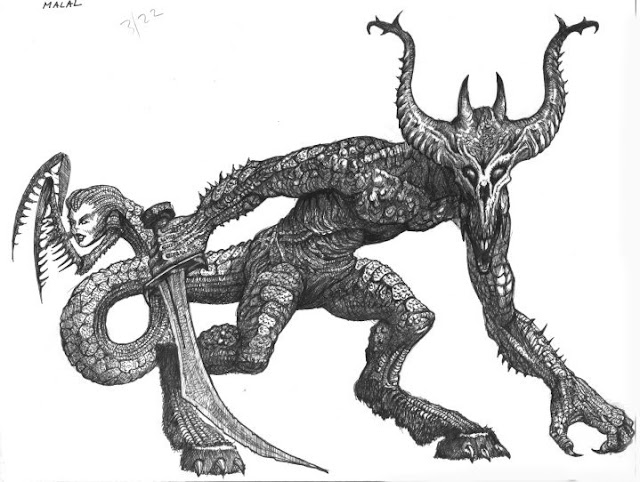
    TA: The core idea came from Bryan's fascination with the chaos gods featured in Michael Moorcock's Eternal Champion books. Bryan came up with the names and attributes and got John Blanche to provide some rough sketches of each of the four gods. From then on it was up to me to develop those ideas. There was at one point a fifth god Malal (unseen) created by John Wagner and Alan Grant (the Judge Dredd writers) and drawn by Brett Ewins for a strip in the Compendium or Journal (I can't recall which). 


    Unpublished concept of Malal daemon
    TA: This god (Malal) was prevented from being used in RoC because Wagner and Grant had ensured that they had the copyright. This was not realised until after I had created the visuals for the God and it's associated beasts. In the case of the beasts I would create finished visuals and we would get around to discuss which to use or not. The mutations of the warriors was left up to me.

    Khornate daemon engine, one of the last pieces of artwork Tony produced for GW in 1991.
Unpublished Warhammer battle scene illustration 


Unpublished Realm of Chaos illustration 
Unpublished Realm of Chaos illustration
Unpublished concept are from The Lost and the Damned - presumably a scaling study between the Lord of Change, a Flamer and a Horror. Fascinating...

Unpublished Realm of Chaos sketch
RoC80s: The image above is an intriguing one. It reminds me of the interior illustration used in Slaves to Darkness to overview Slaanesh and Khorne. Here we see Nurgle daemons in ranks similarly to the well known illustration (shown below for comparison). Interestingly, the Beast of Nurgle here resembles the unreleased version (which was not big enough, see it here) rather than the more well known miniature. The absence of this type of drawings was one of the biggest surprises for me when I first read The Lost and the Damned. Presumably, there was also once a Tzeentch version. I asked Tony for more detail.

TA: Originally there was only going to be one book.  So the initial compositions for the various daemon header sections were designed to be compatible.  The plan had been that vast majority of the artistic work would be up to Ian Miller and myself with occasional artwork from various freelancers.   What then happened was that too much text was generated (a ratio of text to illustration had been established at the beginning of the project) for one volume.  So it was decided to make it a two volume project.  After the completion of Slaves to Darkness it was necessary to return to other projects that had been put on the back burner.  So effectively the Lost and the Damned was a less focused project.  In the intervening time Ian became involved in other things and the studio grew and more artists were employed, the result being that the initial vision was somewhat diluted.
The famous depiction of the two opposing forces from Slaves to Darkness. 
RoC80s: After Realms you moved to Flame Publications and became involved in lots of RPG products, particularly the much loved Marienburg series and Confrontation- the game that would one day become Necromunda. How different was the original concept to the one we eventually saw?

TA: It was a big morph. Some of the background was published in WD. There was about six months of artwork genearated by me that never saw the light of day. It was considered to be more suitable for an older audience than the one they were aiming toward, and that being an RPG it wouldn't generate enough figure sales. The material that appeared in Dwarf was edited down from the original by Flame Publishing (which at that time consisted of Mike Brunton, Graeme Davis, and yours truly). Flame was created to produce RPG stuff for GW mainly for Warhammer Roleplay. It contributed all the Marienburg material for Dwarf. For various reasons (none of them illegal) GW promoted the illusion that Flame was a separate company. A couple of creature that were intended for Confrontations. One with very alien overtones.

Confrontation alien, previously unpublished.


Confrontation alien, previously unpublished.
  • RoC80s: How involved were you in the Marienburg project? Did you just provide the art or did you have a larger role in generating the background?

  • TA: The original idea for Marienburg came from Richard Halliwell. The scenarios that appeared in WD were edited by Mike from material supplied by various freelance writers and Graeme. There were a couple of times I remember Mike and myself arguing with Graeme over the look of a character. But other than that it was three friends contributing what each od us did best. There was one scenario I ended up stopping publication of. It was based on the characters from the Maltese Falcon. A major difference was that Gutman (The character played by Sydney Greenstreet in the most famous film adaption) ran a brothel in addition to his other nefarious activities. Given that WD was increasingly being aimed at a younger market it hardly seemed appropriate subject matter. Because the text and illustrations had been completed the idea was to use the scenario in a compendium type publication has Flames readership was somewhat older. In the event it never saw the light of day.

Old Mother Crumbhorn - one of Fantasy Roleplay's most horrific characters.


That's your lot... I hope you have enjoyed this walk down memory lane, and hopefully you have learnt something new along the way. A MASSIVE thank you to Tony for sharing with us his memories and his work.


Enjoy,

Orlygg.