|
| A winning entry indeed! The Great Spined Dragon, here converted to be a Plague Dragon, was painted by David Chauvel and won Best Dragon at the 1988 Golden Demon Awards. |
Ever since I saw the Great Spined Dragon being painted up by Harry, I knew that I had to own one. It is, quite simply, the finest dragon ever sculpted.
To quite frank, it is exquisite.
A photograph cannot do the model justice. Once you have the pieces, and you roughly assemble them together, and balance the model in the palm of your hand, you know that you are holding something so very special. It feels like it wouldn't take much; a nudge perhaps, or a gentle blow of air from your lungs, to encourage the little beast to take flight and sail around your living room on its skeletal wings.
I think this magic is conjured by its eyes. They are small, beady things that peer out from the craggy brow with a malicious intent, almost as if they are appraising how easy a meal you would make! The head too is so finely sculpted that it positively oozes character.
Its limbs are based, not in fantasy as so many sculptors who work on dragons do, but very much in reality. There are distinct echoes of birds of prey in its pose. Closer inspection reveals the muscle structure finely sculpted under the scales, suggesting the inner workings of this strange reptilian monster.
I managed to get one on eBay for £97. It was worth every penny. Even my wife, the non-leadhead, was impressed when she saw my rough assembly, promptly stating 'oh, I like that. If you paint that up, you can keep it on the mantelpiece.'
Surely, the ultimate praise any model can possibly receive?
 |
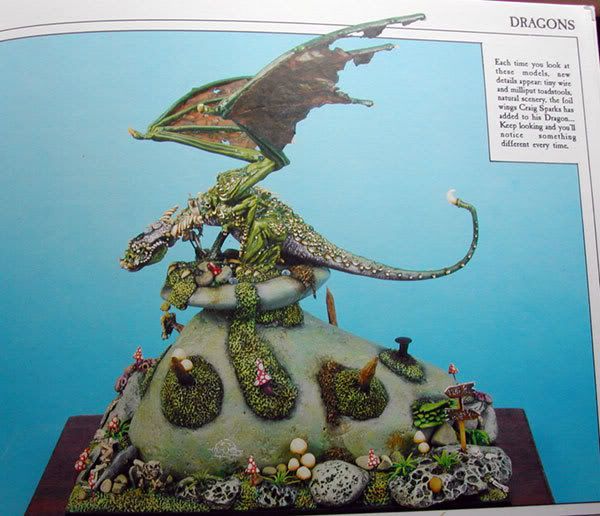
| Then there is this example, painted by Craig Sparks, and also entered into the 1988 Golden Demon Awards. |
The model seemed to be popular back in the 1980s, as the two images that I have published above prove. It was used time and time again by painters entering the Golden Demon awards of the later '80s. And the model must remain popular to this day to command such a healthy price tag.
Having become infatuated with the model upon its arrival in my home yesterday, I decided to do a little research into the model and present my findings as this post. I knew that it was sculpted by Nick Bibby as I had approached him for an interview here at Realm of Chaos 80s and had asked several questions about his dragons. Sadly, he was far too busy to talk to me and the questions remained unanswered and the research drew to a close. The arrival of my dragon changed all that, so I set about exploring the dark corners of the web to see what I could uncover.
Before I present my findings, have a quick look at my dragon as he currently stands. After I have complete this post I am going to finish cleaning him up and stick him together.
 |
| A quick snap of mine, held together with Blu-Tak and propped up on a London Taxi. |
It appears that the model was released in late 1984 or early 1985 and was one of a great many dragons that Citadel was producing at the time. Building and painting them seemed to be a hobby in its own right by the mid '80s, and Citadel had flooded the market with a huge range of dragon models. As early as 1982, the sculpting team were producing dragons of considerable size (such as the 'chicken dragon'), and the sheer scale of these beasts must have been casting nightmares!
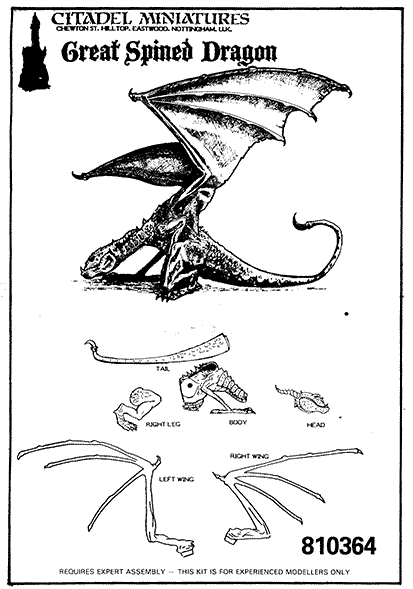
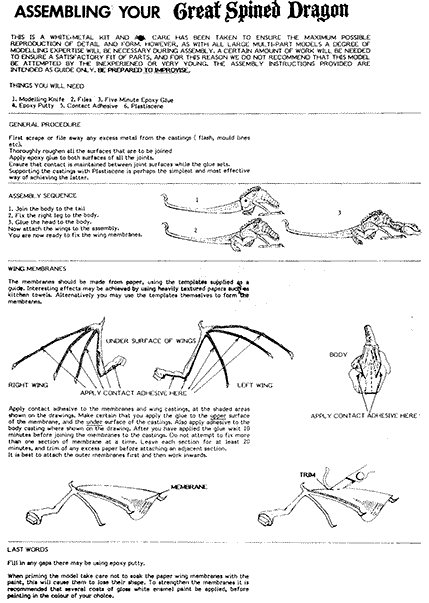
What follows are the instructional materials produced by Citadel to accompany the release of the model. The first is a flyer that includes a breakdown of the model into the cast parts and the sketch produced by Tony Ackland. These documents prove to be extremely useful for anyone interested in building and painting this model today, as I am sure many of you are aware, the Great Spined Dragon was sculpted without wing membranes and these, with a little modelling skill, need to be produced and attached to the model. The second side of the leaflet detailed how best to go about this, explaining where to stick the membranes to produce the best possible fit.


Rooting around further, I can across this second flyer, now in the collection of Steve Casey over at Eldritch Epistles. Here we find the original mailing list gumph which included a rather whimsical piece of background fluff about Spined Dragons in the Warhammer World as well as some rules for the beast, as geared towards Warhammer Second Edition, which were current at the time.
But what of its sculptor? Then, luck struck and I stumbled across a blog called the
Spyglass Asylum, which sadly has not seen an update for some time. The writer of this blog was also a big fan of the Spined Dragon and wrote a lovely article praising the piece. Thankfully, Nick Bibby contacted this blogger and provided some further information about this most wonderful of dragons.
Here is the text.
NB: Well, this is a blast from the past! I came across your blog, whilst looking for something else entirely, and was stunned by the comments. Not a blogger, never posted before, so this is a first. I thought old "Spiny" was well and truly consigned to history. I think I sculpted him in 1982, or 1983 but couldn't swear to it. It was certainly before my allergy to epoxy caused me to switch to Fimo [Kegox, Mordax, etc]- Spiny was sculpted in 'Green Stuff'. He was my rebellion against all those dragons with silly flappy little wings and no musculature to use them. I wanted to sculpt a believable dragon, as anatomically correct as possible with proper wings and the musculature to use them - something that looked like it really existed, Structural anatomy has always been an interest of mine - how can you sculpt a subject without understanding the underlying skeleton and musculature? It gives the surface texture it's form. At the time, he wasn't hugely popular - a lot of people simply didn't get it. So I'm chuffed that somebody likes him now!
I did a painted diorama with a tweaked Spiny back then - how I would have sculpted him, if casting wasn't an issue. It won the professional class at the first ever Golden Demon awards. I still have it in a box somewhere. If anyone is interested, I'll dig it out and take a picture. One day I will do another "Real" dragon, but in bronze. Well, More power to your collective elbows, and thanks for all the kind words! Best wishes, Nick Bibby.
NB: I think I may have one of the very last Spined Dragon ever produced by Games Workshop - they offered a service in the late 90's/early 00's where they said they could reproduce any model if they still had the mould. I rang up to check if they still had the mould for the Spined Dragon and was pleased to discover they did - I think I paid around £35 for it. Not long after it arrived, I decided to get another but was told that the service had been pulled.
I still haven't been brave enough to build and paint it though so its still in its box.
Well, there lies the reason why the Spined Dragon is so treasured by so many. The artist who produced the model thought long and hard about the creature, and treated it as a living being, rather than just a fantastic creature. I have said it before, no technique can be a replacement for 'soul'.
I guess the Spined Dragon proves that point once again.
And in case you are wondering what Nick Bibby is up to now, have a quick look at these photographs I took from his website. They show some of his later sculpts in great detail. It seems, in the years since Nick Bibby left GW, he has moved to to become one of the greatest bronze sculptors in the world, with a catalogue of work to make an museum proud.
 |
| Nick Bibby's Snail... I looks real does it? Wouldn't make a perfect old school giant snail for Oldhammer games? I bet this is worth a lot more than I paid for my Spined Dragon though - just look at it! It could be alive! |
 |
| This is a pretty recent shot of Nick working on an enormous sculpture of a bear. Incredible! |
If you want to see more, and I really do recommend that you do, check out his website here by following this link
http://nickbibby.com/gallery.php. Before I sign off, imagine this for one moment. In his comment to Spyglass Asylum above, Nick stated that he would one day sculpt and cast a dragon in bronze. If that work of art was anything to the scale and brilliance of what can be seen on his website then, hopefully, the Great Spined Dragon will one day be the second greatest dragon ever sculpted.
Right, I am off to stick mine together and decide exactly how I am going to approach the base and wings of this fantastic model.
Orlygg.