Unless you have been living under a blanket, like me, you would know about GW's BIG ANNOUNCEMENT yesterday. In truth, I wouldn't have known about it save for the excited chitterings of my friends Stuart Klatcheff and Steve 'The Artist Formerly Known As The Citadel Collector' Casey.
There is to be YET ANOTHER edition of 40k, albeit one that looks to be following a similar line to Age of Sigmar. Take a look
here if you are curious (or have been living under a blanket.) Personally, I have lost count of the edition number now but I am sure that there will be readers out there who can put the record straight on that department, so please do in the comments.
Considering the purpose of this blog is to document OLD GW products and chronicle, in a semi-literate way, my adventures in nostalgia I thought it prudent to travel back to 1987 and White Dwarf 93 to see how the original launched was handled. Not only will we look at that, but I also intend to discuss the early releases for Rogue Trader as the look and feel of the game rapidly changed as Bryan Ansell and co recognised its unexpected success. Rogue Trader/40k went through a series of changes before it became 2nd edition, and though this is a fascinating story in its own right, it it not the purpose of this post to go into great detail about it, simply to compare THEN with NOW.
Okay, que whimiscal ancedote and let's get started!
My first recollection of Rogue Trader? Hard to pin down really as I was really a fantasy fan, but I am sure it wasn't White Dwarf that switched me on to the game by a local boy who lived a few miles from my home. We got taking at school after I spotted him drawing space marines inside a school dictionary and within days we were regularly playing our version of the game. All I recall now of those early battles is the damp darkness of my friend's bungalow attic, the smell of mouldy carpets and ranks of appallingly splattered space marines and orks.
But fantasy soon pulled me back, though I would return to the sci-fi scene with Space Marine some years later. In fact, my journey with Rogue Trader didn't truly begin to around 2004 when I started buying up old issues of White Dwarf, especially those I had never read previously. I started with issue 90 and collected them roughly in order. In the pre pdf days this proved to be a time consuming but rewarding experience as I saw how the game I new quite well by then, had its birth and brief childhood.
Enigmatic advert for Rogue Trader, published on the inner front cover of White Dwarf 91. The first major advert for the game published.
The game certainly has an interesting history of development. GW always stated that they would release a game called Rogue Trader that would be a space age adventure roleplay system similar to Traveller. It took on many guises over the years but had mutated beyond the original remit. Bryan Ansell, who had control of the company by '86, saw where the money was and commissioned big book versions of Warhammer Fantasy and Science Fiction to help sell the miniatures churning out of Citadel Foundry. Rogue Trader was around, so it was affixed to the Warhammer brand and the most successful wargame in history was born. Along the way the game evolved from a wacky science fiction skirmish game into a detailed, large scaled battlegame that involved vehicles, fortifications and a great deal of Space Marines.

The first page published in WD concerning Rogue Trader. Nice graphics don't you think? Its all there from the very beginning; the aquilla, the chapter badges (though they are far more intricate here) and the star speckled background of a wild and varied universe.
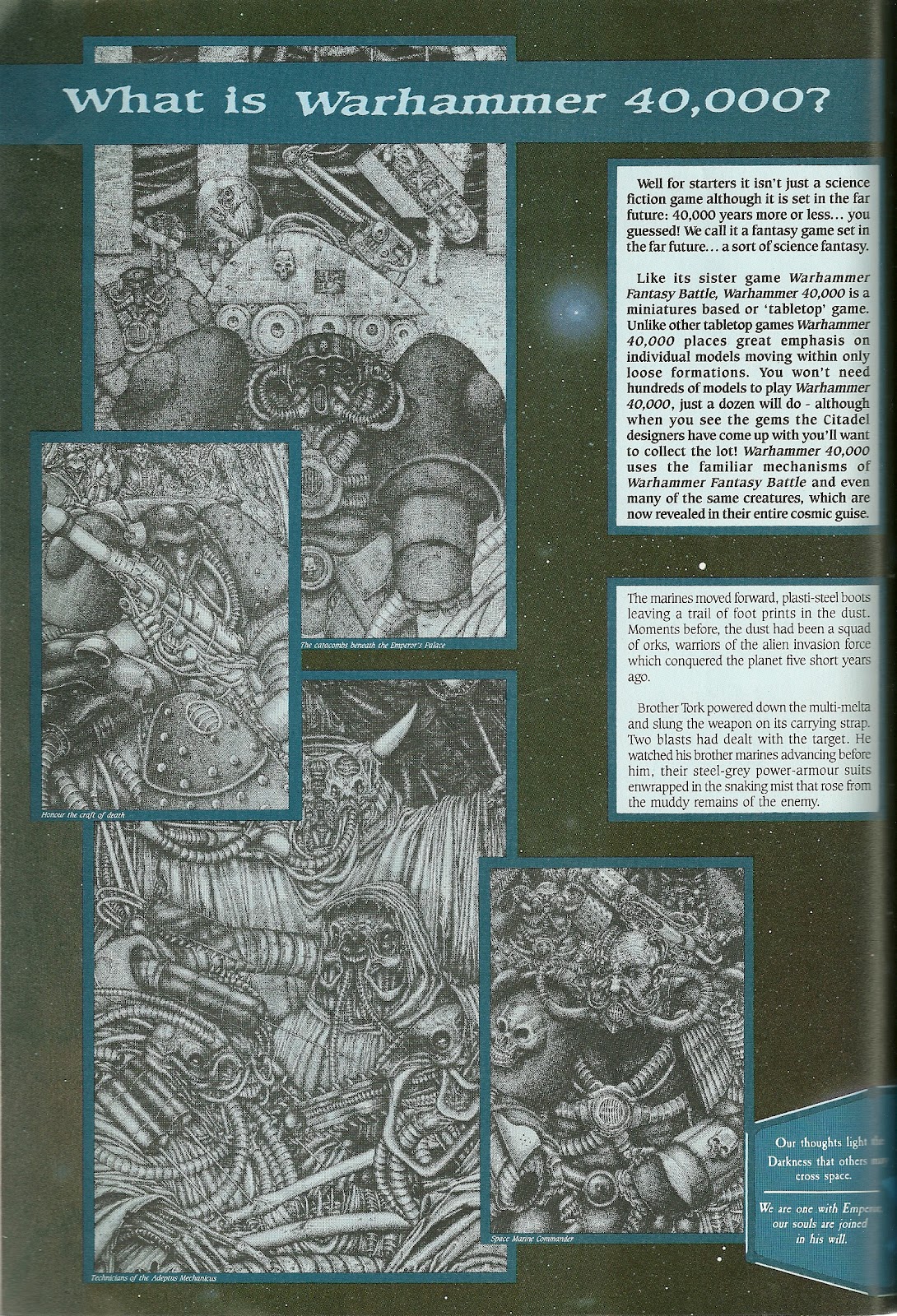
Launch articles are always a great way of exploring the original feel of any game, and thankfully we have a very nice one to explore published in WD 93. The first thing that strikes a reader when flicking through these pages is how focused the artwork feels, unlike in previous GW publications of the era (WFRP and WFB in particular) the artwork in Rogue Trader couldn't just be a splurge of the nicer pieces of fantasy art that GW had produced over the previous decade, it had to be something new and, for the first time, coherent. Another thing that strikes a cord when reading through this little manifest is that GW intended for their three core games (WFRP, WFB and RT) to share a certain philosophy and a mythos, something they are keen to stress is not the case today.

"For more than a hundred centuries the Emperor has sat immobile on the Golden Throne of Earth. He is the Master of Mankind by the will of the gods and the master of a million worlds by the will of his inexhaustible armies. He is a rotting carcass writhing invisibly with power from the Dark Age of Technology. He is Carrion Lord of the Imperium to whom a thousand souls are sacrificed each day, and for whom blood is drunk and flesh is eaten. Human blood and human flesh- the stuff which the Imperium is made.
To be a man in such times is to be one amongst untold billions. It is to live the cruellest and most bloody regime imaginable. This is the tale of these times. It is a universe that you can live today if you dare- for this is a dark and terrible era where you will find little comfort of hope. If you want to take part in the adventure then prepare yourself now. Forget the power of technology, science and common humanity. Forget the promise of progress and understanding, for there is no peace amongst the stars, only an eternity of carnage and slaughter and the laughter of thirsting gods.
But the universe is a big place and, whatever happens, you will not be missed...."
A so it began... The famous description of what Warhammer 40,000 really is. A dystopian wargame with medieval fantasy elements. This passage has be re-worked since, several times, but the crux of the piece 'There is no peace, no forgiveness; only war' is plain for all to see. I am without doubt that the new edition revealled yestarday will share many elements of this opening text.
I find this page rather interesting. What we have are the prototype chapter badges of many of the marine forces we know today.They are certainly more intricate than they would later become and several of them have disappeared from the canon (Rainbow Warriors anyone?).

The first thing that strikes me when looking back over these documents with fresh eyes is the artwork. Its certainly very different to the black and white fantasy line work that GW had been commissioning for the previous ten years. Its black, scratchy and contains many meldings of flesh and machine. It is sinister too! No heroic Space Marines yet, just dangerously psychotic cyber warriors that seem more closely linked to a chapter of the Hell's Angels rather than the Angels of Death. It is clear that at the time of conception, the artists had a pretty free reign to draw what they wanted. Sure, they had the plastic kits and a few metal models but the 'look' of power armour had let to be defined so its far more wild and varied.
It is also pleasing to see the 40k 'thoughts for the day' evident at this early stage. These little snippits of wisdom were always of great interest to me and I have always felt they helped protray the blackness of the 40k universe without the need to be especially GrimDarktm.
'Our thoughts light the Darkness so that others may cross space.'
'Praise the Emperor whose sacrifice in life is ours in death.'
The article itself begins with a strident declaration that this is not a science fiction game. 'We call it a fantasy game set in the far future... a sort of science fantasy.' And that there was a strident attempt to link the game with the very well established Warhammer Fantasy Battle by calling it Rogue Trader's 'sister game'. Something that is clearly the case as 'Warhammer 40,000 uses many of the familiar mechanisms of WFB and even some of the same creatures, which are now revealed in their entire cosmic guise.' Another early confession was the fact that this was intended to be a skirmish game in which just 'a dozen' miniatures will do for a session, though, of course, there is a remark that you'd 'want to collect the lot'. Its clear to see that Bryan Ansell and co didn't quite realise the hit that they had on their hands and that over the next three years they'd expand the game considerably.
We also have the first piece of 40k fiction. A short tale about one Brother Tork of the Space Wolves Chapter. It does well to communicate the small scale nature of the game and its themes of interstellar horror and corruption. Of interest here is mention of the homeworld of the Space Wolves being Lucan. I wonder why it was changed?

'Warhammer 40,000 takes the Warhammer Fantasy Roleplay background into the Galaxy itself.' Mythos is a word used frequently in the launch article, as if GW were attempting to build a world comparable to Lovercraft, Howard or Tolkien. The three writers are obviously big influences (though not as great as Moorcock) on the development of the background. These days, GW work hard to tell us that their games do not share the same worlds even though certain deities and characters appear in both WFB and 40k. The aim of the background was explained at the time as 'to create an almost medieval attitude amongst the human societies. Fear, superstition, self-sacrifice and common acceptance of death are all strongly featured. Technology is present, but it is not central to the way people think. Most common folk see technology as witchcraft- so do the technicians!' This is still a core element to the background.

The first ever Space Marine model is used here to give gamers a glimpse of the future. The prototype for the plastic Land Rhino!
The now familiar background is discussed in detail. Love that Blood Angel camo paint job!

Here's a nice quote:
'In Warhammer 40,000 technology takes a definite backseat, but that doesn't mean that there isn't any to be found. In fact, there's a whole range of advanced weapons, armour types and equipment. The range of technology available reflects the diversity of humanity, ranging from the primitive crossbows and slings used on feral worlds to the barely understood digital and force weapons carried by rich and powerful individuals.'
I really like this about RT. If you are familiar with Warhammer Siege, you'll probably know the picture of a skirmish fought within the walls of the Mighty Fortress. Its a rogue navigator who's enlisted some primitives to aid him. These types of game (a mix of WFB and RT) have always really, really fascinated me and would be fairly easy to develop, considering I have some many fantasy models and plenty of scenery, I'd merely need a handful of spacey Citadel characters to provide the technology.
Oh, gods! Another project!!! Noooooo!

Lovin' the Cowboy Style Inquisitor here!
 |
| Here is a thinly disguised advert for the initial 'forces' releases, Space Marines and Space Ork Raiders. |
Ahhh, the first two box sets. Someday I'll get hold of these. The plastic space marines box set is one of the Holy Grails of collecting, though they do turn up with greater frequency that the Citadel Giant! The marines were a really ground breaking kit at the time and you really could go wild with the models and produce totally wacky miniatures. An iconic release really. The Ork Space Raiders were metal (why no plastic ork set?) and had a lovely whiff of the 'Black Widows' Biker Gang from the Clint Eastwood classic 'Every Which Way But Loose', mixed with 80s street punk.

Here are the additional metals released alongside. At this time, Citadel were still naming many of their metal releases and there are plenty of amusing names here; Brother Quiff? Brother Longun, Top-Knot Tone, Spiky Eddi and the brilliant Hippy Hogsbreath. The figures shown here are VERY different to what 40k would become and share much with popular 'franchises' of the day. 2000AD, Mad Max and WW2 clearly show their influence, though the orks look fantastic thanks to Kev Adams' genius. What ever happened to the gobinoids? ):
White Dwarf 94 - the first issue after the launch of Rogue Trader
Really old people or retro consumers will be aware of White Dwarf's 'Open Box'. This was a section of the magazine used in the 1980s to review gaming supplements and general what-nots. On its hallowed pages you could read reviews of anything and everything from AD&D adventures to Ghostbusters the RPG written by such visionaries as Jim Bambra, Marc Gascoigne, Stephen Hand and Paul Cockburn. As the focus shifted away from Games Workshop (a trading company that sold fantasy games) to Citadel Miniatures (a miniature manufacturer selling lead and rule sets for lead) the decision was made to jettison the non company products and focus on GW's own stable of releases.
Hence no need for Open Box any further. A new series what introduced, entitled Marginalia, which set out to give a soapbox to designs to talk about the decisions they had made during the design process of a particular product. The first to step up to the mark was none other than Rick Priestley, author of Rogue Trader. His account is fascinating and is full of interesting points. I have reproduced it here in full.
According to Rick, Warhammer 40,000 Rogue Trader was something of a first for the erstwhile games designer, for it was the first project he worked on on his own. He'd previously contributed to Warhammer Fantasy Battle, Warhammer Fantasy Roleplay and Judge Dredd. Strangely, Rogue Trader had been written before any of the previously mentioned games were designed but it was always put to one side as other more pressing projects pushing their unsightly heads to the fore.
It was originally intended to be one of the 'freebie' games that would be given away with purchases by mail order customers, one of the other 'freebies' being what would eventually become Fantasy Battle. The popularity of this particular game (work was being done on its third edition concurrently with Rogue Trader) established the format for future games. Rogue Trader was 'rethought' from the ground up using many of the mechanisms worked out from Warhammer Fantay Battle. At the time, Rick thought this relationship was essential 'not only for the sake of the system, but also for the background mythos and general "feel" of the game.'
Rick describes the development cycle of the game as 'fitful'. He states that many ideas that were developed for Rogue Trader found their way into Warhammer 2nd edition. 'By now the "dark and dangerous" background for Warhammer had started to evolve, partly based on ideas by Bryan Ansell, and partly on the background of the Citadel miniatures ranges.' This point is interesting, as even at this early stage, GW were making design decisions based on the models that they were designing and selling. These judgments were a little more restrained than they are now, thankfully! By now, Rogue Trader existed as a rather tatty print-out (imagine the reams of that old concertina computer paper, the stuff with the removable holes) and rather than re-type up the manuscript, Rick chose to begin again afresh now that the unfinished WFRP had been handed over to Jim Bambra, Graeme Davis and Phil Gallagher.
Since a previous re-write, the basis of Rogue Trader had been based firmly on WHFB. There were a couple of problems as Rick explained, 'But the first crunch came with the change in emphasis away from hand-to-hand combat towards fighting with ranged weapons.' Problems persisted in creating a believable ground scale for weapon ranges. Priestley opted to work with abstract ranges and went on to state that 'even though ranges are very short in realistic terms, the differences between different weapons ensured that their vital qualities are less distinct.'
Another issue Rick had to deal with was the damaged caused by powerful weapons. He needed to rethink that standard strength and damage system used in Warhammer. 'With the new game (Rogue Trader) I wanted to allow more powerful weapons, but also had to maintain game balance. Simply increasing a weapon's strength would destroy this balance. To make weapons more effective, therefore, I introduced an additional modifier to the target's saving throw. In Warhammer this modifier is linked to strength but in Rogue Trader the link was broken. There are weapons that can cut through armour like a hot knife through butter, but then do relatively little damage - the laser for example. At the same time, I introduced a variable damage roll, allowing some weapons to do more damage than a wound with a single hit. This was necessary in the case of large weapons, where targets with large wound scored were likely to be engaged. All these modifications do make the shooting procedure more complicated than in Warhammer. I felt this was appropriate for a game involving fewer models and a greater variety of weapons.'
Again, Rick discusses that close link between rule development and model design, 'there was only so much modelling time available, so there was no point in having space marines armed with loads of tiny weapons if the figure designers only had time to create a single marine model. The models were influenced by the rules and vice versa. Just why is it that when you're just about to finish a section, some... person... walks in in which his latest cybernetic killer clone-armadilliod lobotomised space-nun and her amazing drone weeble dog, and wants the rules of using it... Sob.' However, there is no mention here of the Sales and Marketing boys who have just completed the number crunching and discovered that the forementioned space-nuns are are selling like hot cakes and need extra umphh adding to their stat line as well as an aggressive marketing campaign in White Dwarf liberally peppered with the adjectives 'cool' and 'awesome'. What we have here is a design relationship between the model makers and the rule writers that seems entirely positive and creative. If that really was the case cannot be known from this article, but it certainly seems far more healthy than the current regime's attitude.
Still, there were even more teething problems for Rick to resolve before the game could be published. 'By the time the game was ready for editing in December 1986, Games Workshop had decided to produce Rogue Trooper.' This game was based on the popular 2000AD strip of the same name and Citadel had produced and small range of miniatures to support it. 'The ensuing confusion was incredible, with people talking about Trader when they meant Trooper and Trooper when they meant Trader. Gurgling quietly often became the only option.' After discussion in the studio a new title was coined by 'some bright spark' that Rick confesses he would 'hate for the rest of his life' came up with Warhammer 40,000 Rogue Trader, though Rick preferred 'Warty Thou'...
'The publication of Rogue Trader,' Rick summed up, 'opens up a whole new area of supplements, scenarios, modelling, articles and more of everything. The first supplement is already in preparation, and I am looking forwards to throwing myself into further game development. The Rogue Trader universe was designed for gaming right from the start, and has plenty of room for future ideas - with over a million planets in the Imperium, there's room for players and other writers to develop virtually anything they want!
Go forth and develop!'
Little did they know what a juggernaut of gaming Rick had unleashed onto the world and develop it they did... Changing a small scale skirmish game into the most successful table top game in history.
Advert for Rogue Trader taken from White Dwarf 94. Note: before Chapter Approved reared its sci-fi styled head, the powers that were toyed with 'Imperium Approved'.
We willl remain with WD94 for a while longer and will discuss the second scenario published for Rogue Trader (the first being the rather lamely titled, the Battle at the Farm, in the Rogue Trader rulebook) called 'A Skirmish on Rynn's World', authored by the mega-talented Rick 'I am largely responsible for modern wargaming' Priestley (and no, that isn't an officialTM Priestley quote).
This is a title that should be familiar with modern 40k audiences. Rynn's World has an iconic place in 40k history, with novels and fluff aplenty published about it. Subsequently, we needn't discuss the background to the scenario too much. A brief overview will be sufficient, I think!

The battle that this scenario describes is that of Jadeberry Hill. Not very GiRm DaRk is it? Jadeberry Hill sounds a bit like a place out of a girly children's programme and not a violent, futuristic table-top wargame. Still, it fits in with the Battle at the Farm for being suitably '80s naff. The article continues to explain that Rynn's World is part of the 'Rynnstar' system located near to the Orkish Empire of Charadon. This area of space is ruled by one Arch Arsonist by the name of Snagrod. This vicious and sadistic leader has plotted to invade the planet, despite the presence of the Crimson Fist Chapter of the Space Marines, and launched his invasion ten days previously. Incredibly, a one in a billion chance saw the shields protecting the Space Marine's base malfunction just as an enormous rocket crashed into it; wiping out most of the Chapter. Only the group at the Farm and one seconded to the Defence Force of New Rynn City guard are left alive... Suitably stirring stuff...
The rest of the article contains the GM's notes. Remember, at this time Rogue Trader was intended to be a skirmish game with a heavy roleplay element. The thought that people would go on to play massive pitched battles had not yet fully developed. The idea was that you would only need a few models to play Rogue Trader, after all, at this time Warhammer was king of the castle and Citadel were shifting over a million metal models for that particular game a month.
I won't elaborate on the GM's notes, I'll leave you to read them yourselves (just in case you're planning on running this scenario with some friends and don't want to be 'in the know' so to speak) but I can say that they cover a few interesting tactical problems for both the Orks and the Space Marine player. Just reading them gets me all excited for the tactical side of games like this instead of just 'Cleanse and Burn' tediousness. One thing that is interesting are the notes on the set up of the playing area. The name of the famous 'Pakomac' River is misspelt as 'Pakamac' on several occasions in the text and it makes you wonder with hindsight if this was the river's original name. If so, I can see why it was changed; 'Pakamac' sounds like a raincoat you'd screw up in a sack and take to a music festival, doesn't it? Again, not very GrIm DaRk is it?
There are a few notes that give suggestions about how to incorporate this game as sequel to 'The Battle at the Farm' from the Rogue Trader rulebook, as well as giving a few suggestions about how to create further games. They really is quite a lot of scope here for some excellent campaigning with a little effort.
Next up, we are given an interesting summary of the all the weapons and equipment used in the game, including some more typos (was this article produced in a rush?) and an intriguing mistake where the word '***piccy' appears where it should say 'Chainsword'. This is really quite useful to photocopy if you fancied a quick game as it has all the details needed to play any game of 'Early Rogue Trader'.
Two further pages remain in the article and these go on to describe the forces used in the engagement. Looking at the detail, I have most of the models required to play this scenario, though some missile launchers are still required for the Space Marines and some Heavy Bolters for the Orks, nothing eBay or a social media trading group couldn't remedy though.
Overall, a nice little article and I have included a link to a pdf copy of the scenario at the bottom of this section if you are interested in a little further reading.
Moving on, and there is a nice little colour page detailing some Rogue Trader releases for that month. Here we see for the first time some of the Space Elves (not yet Eldar) and the Space Dwarfs (not yet Squats). Both sets, I am sure that you agree, are instant classics. The Eldar at this point have that lovely '80s punky feel and sculpted by the genius of Jes Goodwin are absolute musts for any serious collector. The paint schemes too are suitably wild and alien and I just love the names that they are given... Kern Proudbrow anyone?
The Space Dwarf release is more substantial. Twenty models to the Eldar's (or should we call them Space Elves?) six. I love their design (I too never found GW's 'excuse' for dropping them in any way satisfactory) in a wonderfully '80s biker way (which many of the GW staff were at the time I am lead to believe...). The colour scheme is also fantastic; the green and red and blue working perfectly to create a gritty, almost Vietnam vet looking force of troops that even though are set in a sci fi universe are entirely believable. The names too are amusing, all puns or half-puns on famous guns. I am sure that you will agree that this set is an absolute must for any fan of Citadel miniatures.
Anyway, here is the link to Skirmish on Rynn's World.
Skirmish-on-Rynn-s-World
 |
An advert for the ruleset and, of course, the now famous first two releases; the plastic Space Marines
and the metal Space Ork raiders by Kev Adams. I have most of these models now... |
As you would expect, plenty of Rogue Trader material popped up in White Dwarf 95 to following month. As many of you will know, this particular issue was Warhammer Fantasy Battle heavy... Not only was there a flexi disk of Warhammer inspired music but there was also loads of Warhammer Third Edition release material on offer. So significant is this issue of WD taht I have blogged about various aspects of it over the years. Detail on thre flexi disk cane be found
here. Subsequently, Rogue Trader was a little squashed up in this issue and rather limited.

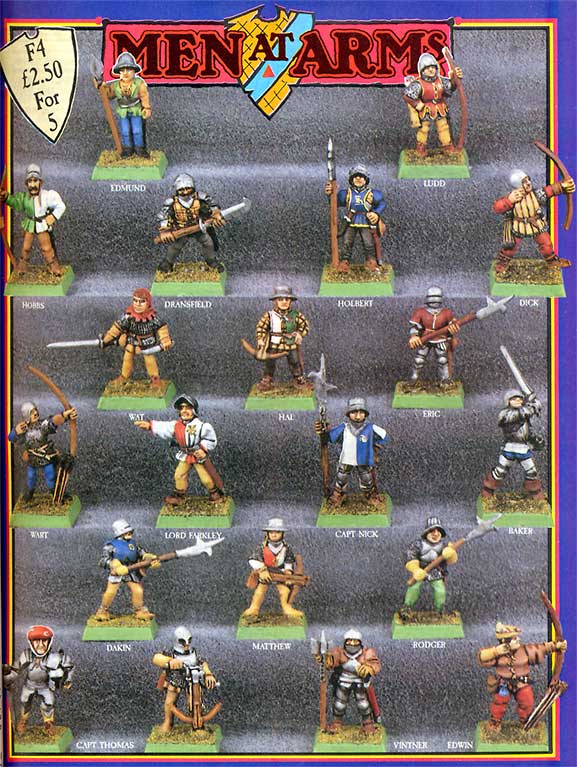
Bob Naismith and the Perry twins produced a wonderful range of space mercenaries here. There are obvious prototypes to what would later become 40k standards. We have squats, ratlings, power armoured troops and Imperial Guardesque soldiers. All the sculpts in this set, as I am sure that you will agree, are extremely well executed and quite varied. These models must have been a real pleasure to paint back in the day (as I am sure they will be today, if you can get your hands on them...) and one theme that I am keen to explore myself when painting up Rogue Trader minis is the bizarre 'future camo' scheme evident on several of these models. I particularly like the colour scheme on Mad Morris with the jet black comet tail effect.
Upon first glance, they look a little disappointing, don't they? That is certainly how I felt when I first saw these models. Compared to the massive modern plastic versions the design boys at Citadel have certainly moved on a long way from these early concepts. However, in more recent years these models have really begun to grow on me and I find them rather endearing now. They positively reek of 1980s design ethic though don't they? What is interesting is the number of weapon options that these first releases were intended to have, and its clear that even at this early stage it was possible to create the armour you wanted.
The colour schemes for the red and blue dreadnoughts lack depth, especially when compared with their armaments, so I would not be taking any inspiration from there. The first model is must better and I really like the way the Citadel painter has managed to achieve that oily metal look, very apt for a giant, robotic killer really! And the faces? They are just begging to be painted, aren't they?
Those of you that frequented the 1980s will no doubt recall the classic television series, The A-Team. Many of you probably watched it on early Saturday evenings as I did. BA was always my favourite character, not because of his tendency to 'pity the fool' or throw bag guys through windows but his skill at building incredible vehicles and weapons from the tools left lying around in garages and lock ups. Rick Priestley shares many of these skills, but instead of fighting crime he produces wargames terrain from the junk that is left lying around.
In this famous article, he goes on to explain (with the help of a few other GW illumni) how to produce vehicles from (yes, that's correct) a deodorant stick and other bits and bobs. Classic '80s madness that is still influential today. People still make this model.
Here is the article in full...
Rogue-Trader-Eavy-Metal
 |
| The First Ever Chapter Approved! WD 96 |
Issue 96 of White Dwarf saw the launch of a series of articles that many 40k longbeards remember with a fanatical fondness- I speak, of course, about Chapter Approved. Its concept was explained in typical style by Rick Priestley at the beginning of the article (read the pdf
here) and to paraphrase the series was designed to 'explain loads of new stuff, fluff and miniatures relating to Rogue Trader'.
The first subject was a new Jet-Bike designed by Bob Naismith. The Mk14 'Bullock'- hmm? I wonder why they dropped that name, eh? The article goes on to provide background about the vehicle, including an amusing 'in game' test report by a pilot by the name of John Blank (who looks surprisingly like a certain head of art) as well as full rules and background.
Additionally, the Raven Wing are introduced. With an interesting piece of fluff that expands on the Horus Heresy (as it was known in 1987) and even incorporates the chapter of the Dark Angels into the fluff set up for the Crimson Fists and New Rynn City. Major characters of the Dark Angels are also introduced and their bike configurations are given. Psyker rules are also expanded on.
 |
| The MK14 Mechanicus Armories Jet-Cycle 'Bullock'. Is it me, of does the Dark Angel on the back of the beast resemble Maniac from Mayhem? Obviously, Norwegian Black Metal was still big in the 41st Millennium. |
 |
| Further releases for the early Imperial Army range. |
Here we have more troopers for the, now extensive, range of Imperial Army troops. There are some lovely, and other not so lovely, sculpts here. My favourites? Trooper Jones with the ork head, Sniper Lang and Female Trooper Vaskez. I'm not a fan of the grey colour scheme though. I much prefer the expanded and developed Imperial Guard that came in later years. With many elements of this release shared with that range, it would be easy to paint these classics up in the black jacket and urban colour scheme design.
 |
| Jet-Cycle models were designed to fit the plastic space marine. The article also saw the arrival of the infamous Christmas marines! Sadly, no rules or fluff were provided for them! |
In the '80s it never took GW long to produce something silly. And the Christmas Marines serve as a suitable bookend to this post. From issue 97 onwards, 40k became an increasingly dominant force at Games Workshop towers and would, eventually, push Warhammer Fantasy Battle out of the waters completely. The game would change considerably through '88 and '89 and turn into a mass battle game complete with armoured transports, chaos marines and terminators. But that game was very different in tone to the inital months of Rogue Trader's life.
Early Rogue Trader is mad. A veritable box of frogs of ideas, adventure hooks and zany models. Forget GrimDark, this was just as florescent as my sister's leg warmers and the headband I wore to school. A funny, frothy and far fetched game brilliant for re-creating wild skirmishes across a billion trillion worlds. All you need is the rulebook and a handful of models. With a new edition of a the game just around the corner, why not pop back to where it all began and blaze a complicated trail of devestation across the 1980s once again.
Go forth and play.
Orlygg