Showing posts with label Warhammer Fantasy Battle Third Edition. Show all posts

Monday, 6 June 2016

White Dwarf 138 and the Last Advert for Warhammer Fantasy Battle Third Edition


Hi all! I am living in limbo at the moment largely due to a complicated and ever delayed house move. Hopefully, I will be set back up and Oldhammering again by late summer and have plans for a far more spacious (yet not so light) painting area in the near future. In the short term, I have to start boxing up my collection for transportation. For the last month or so things have been neatly stacked up in the conservatory but they are in no way ready for shifting via burly men. It's funny, the last time I moved, my Old School Warhammer collection fitted neatly in a single box and now it's a sprawling mess spread across multiple locations! 

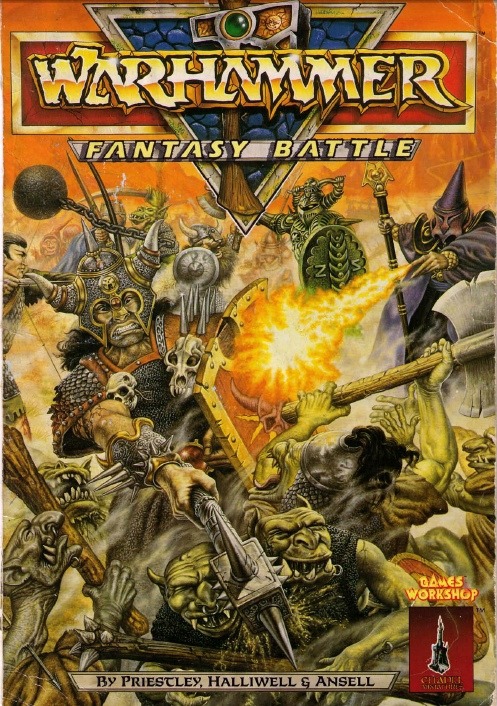
It just goes to show how much lead a man can collect in seven years, eh? It's astonishing when I look at it all. Anyway, as I was 'tidying up' (what this really means is flicking through my stack of old Warhammer mags while the wife doesn't notice my laxity) I came across this little ad in White Dwarf 138 and as far as I can tell it is the very last advert for Warhammer Fantasy Battle Third edition. 

Time to fetch the tissues?


Not that I was actually playing Warhammer Fantasy Battle at this time. I had moved on, as many of us had I think, to the glory of the Big Box Games. I can recall hours of playing and modelling time being pumped into the first edition of Space Marine and the immortal Bloodbowl and the demise of 'classic '80s style Warhammer' passed me by. 

Of course, when my interest in the game was rekindled after a re-read of the WFB rulebook in 1995 it was too late. Fourth edition just didn't cut my mustard, even after I tried so damn hard to get into it. Luckily, this was the era of Hogshead and it's period of publishing Warhammer Fantasy Roleplay, so I switched systems. It still missed GW's glory boy (at least my preferred version of it) but there were at least loads of great spin-off games still being released.


Even ten years later after the birth of the internet as a mass media outlet, my beloved Third Edition of Warhammer was practically impossible to find reference too online.I still clung to my battered copy of the rulebook and felt myself to be the only person in the world who loved that edition like no other and saw every subsequent edition as a watered down version of something once so special. 

Looking back over this advert, I find it all a bit cynical really. One final push on stock in the knowledge that a new edition was being developed just around the corner. But I guess that is just the nature of business, eh? Still, Warhammer Fantasy Battle Third Edition is played more often now than it has been for decades. So there is a little happy ending to this ramshackle blog post. 

Why don't you do yourself a favour and pull out your rulebook and organise a game of WFB3 with your mates this week? You know you deserve it!

Orlygg


Sunday, 27 September 2015

Ten Things Only An '80s Warhammer Enthusiast Would Understand

Does clickbait annoy you too? I am sure we have all fallen in the trap of moving that cursor over that rather intriguing statement or unusual photograph; I know I have. They seem to begin with stuff like: 'She thought she was going to the cinema but what her boyfriend did next blew her mind!' You click the link, and there he is with a large (not regular) box of popcorn! What a risk taker!

My wife is keen to install some kind of filter on the computer to stop pop-up rubbish like this annoying her (she always falls for them you see) and when I have completed this missive, she plans to install Windows 10 - which may or may not have the tools to do so. But at the moment I have some quiet time this Sunday afternoon so I felt like creating some clickbait of my own, Oldhammer style. 

You often see those '10 things that only a child growing up in the 90s would understand' style posts kicking about. A lot of them are awfully poor, but one of two have amused me a little and I thought to do an '80s Warhammer one. 

Hence this post. 

So in no particular order, here we have 'Ten Things Only An '80s Warhammer Enthusiast Would Understand'. Hopefully, you can appreciate them all!


1. You got really excited by the number of blister packs that hung on the walls of GW


In the days before corporate packaging and bland plastic models there was a wealth of wargaming miniatures hanging from rather wobbly pegs suspended from the wall. Hundreds and hundreds in fact and they didn't all have the same tedious card designs either. Orcs and Goblins came in luminous green, Chaos are a rather sickly red and green and so on. You could easily push your way through the throng of gamers to locate the range you were after, though with the rarity of actual catalogues, you never really knew what you might find. 

2. The name of this particular paint made you chuckle.


We all did it. We all stood around the paint section in the stores of old sniggering about the name of this paint. It's very name was encouragement enough to buy it with the pocket money you had to burn. Using it, you would commit painting atrocities on your miniatures when you got home (as using the colour was rather difficult) but you could smirk at the memory while doing so. 

3. Fraser Gray was an enigma! How did he paint that well? With enamels?


He produced miniatures that were truly awe inspiring with that stinky paint your dad used to paint trains and Napoleonics with. You, by comparison, created appalling splodges of colour with the modern acrylic paints. A pattern that has yet to change. 

4. You were unbelievably jealous when photographs like this appeared in White Dwarf.


Bastard! Bastard! Bastard! Why was it that the caption writer made the suffering worse with the phrase 'just some of '?

5. You happily gave these away free to a friend when you switched to Blood Bowl!


Yeah, of course you can have these old books now that I have swapped to the third edition of Blood Bowl. I won't be needing them again. Will I regret it in years to come? Of course I will! 

6. You cut up cereal packets in an attempt to build a model house


Inspired by seminal articles like this, you hastily hack up a couple of cereal packets and attempt to glue them together with PVA. The resulting soggy mess looks nothing like the picture in the article, so you chuck away your efforts and buy Warhammer Townscape instead. Then you buy another copy of Warhammer Townscape as your first attempt to build the watermill involves cutting through most of the book, spilling copydex over the remaining pages and sticking the wrong wall to the wrong roof. 

Happy days.

7. You spent ages looking at the names and photographs of the Citadel crew. 


Another month, another run down of the personalities that made up your favourite magazine. You wish they were your friends, even though the photographs of Bryan always scared you a bit. Actually, you wished you were one of them and got to play games all day long. Because that is all that they did, yes?

8.  You ruined countless plastic figures using poly-cement to stick them together.


Superglue too expensive? No need to worry, as good old Humbrol polystyrene cement is here to stay. You have just bought Skeleton Army, have you? That's a great box set with so many options. You carefully cut all the delicate pieces from the sprue in preparation, then you get sticking. Fifteen minutes later, all of your new undead troops look like they have severe influenza, with long trails of a mucus like substance oozing from beneath their heads and arms. It also took hours for this glue to dry properly, which gave the limbs and skulls of your skeletons plenty of time to slowly move out of position. I don't know how many skeleton armies I saw that looked to be doing the funky chicken, but I lost count at ten.  

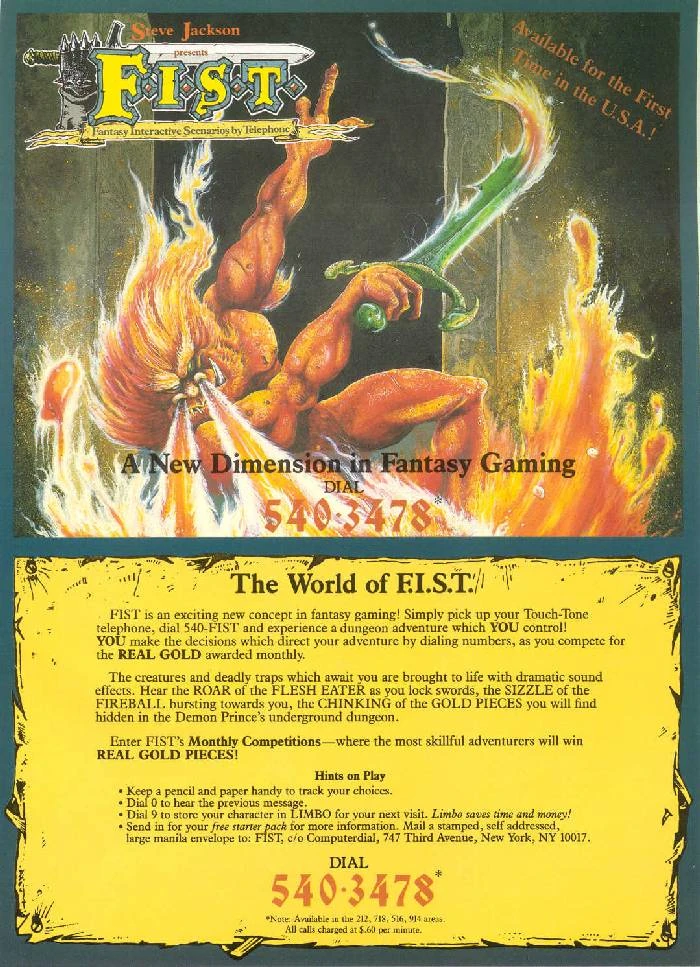
9. Rang up Fist without your parents knowing and got bollocked for the phone bill!


Good old Robin. Yeah, his parents let you do whatever you like around their house. They even swear and tell rude jokes when you kids are in the room. Role models! They won't mind if you encourage Robin to ring the number just after lunch and play through a couple of hours of this! He might win a real gold coin!

I heard he is still paying off that phone bill. 

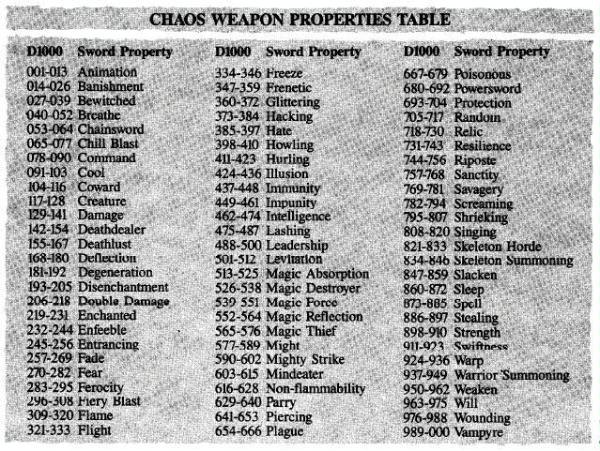
10. You lorded it up with your many sided dice over enormous tables

You felt all 'grown up' and 'sophisticated' because you rolled endlessly on innumerable tables such as this. Hang about, you still do!!

Can you think of any other to add to the list?

Saturday, 22 March 2014

Acceptable in the 80s: The First Warhammer Battle Reports

The publication of the Dwarf Mountaineer rules in White Dwarf 116 was, in my opinion, the last fresh rule release for Warhammer Fantasy Battle Third Edition. There were more articles to come, however these were all tasters for forthcoming publications (such as The Lost and the Damned) rather than something totally new to the game. 
There were other fantasy rules and scenarios after WD116, but much of this was related to Heroquest and its follow up, Advanced Heroquest rather than WFB3 itself. Apart from some background material, the Marauder Miniatures line and a few odds and sods (mostly scenery building or army painting articles) Third Edition was 'done' as a game. The future would very much be Rogue Trader, and the big box games.
However, during this time a new idea crept into White Dwarf. An idea that began with rather charitable beginnings but would later grow to be an ubiquitous part of WD and one that became much derided. I speak of the battle report!

Many of you will be surprised to find out that the battle report wasn't always part of White Dwarf's regular output, and indeed did not become a regular feature at all until well into the 1990s. As far as I can tell, the first recognisable battle report appeared in White Dwarf 107 and was actually a report of a fundraiser rather than a design choice made by Games Workshop. The Roundabout Youth Club organised a twenty-four hour game of WFB3 as part of ITV's Telethon (no, I don't remember them either!) and an overview to the action was written up by Robin (future GW employee and White Dwarf editor) Dews.


Looking back over the article again, what really surprises me about the very first battle report is how many of the key features of the future were in place. There are photographs of the action (well, grainy back and white jobs - it was the '80s!) and difficult to interpret maps of the battlefield. Actually, this is rather cruel an observation as with a little effort it is possible to work out most of the movements of the troops during the game on the map, especially with the addition of a key. The piece also begins with a little bit of narrative to get the battle going, and this story is returned to several times during the article. In later years, the narrative became my preferred part of the battle reports that I would read, but as GW and WD began to lose writers who could actually 'write' these became rather generic and dull, at least to me anyway. 

Reading through the article's introduction brings back a great deal of memories of my own gaming in the 1980s. The plaster covered polystyrene tiles being once such fond memory. Now these were really good value and are still available, see here for example. I think I may well do a few old school experiments with these in the summer months and try and create a Carik Mound of my own. Another things that strikes me is the willingness to just chuck everything on the table and just get on with it. No rules lawyers here. No armybooks or rare choices either, if the group wanted to field it, it went on the table. A quick look through the opposing forces reminds us all what fantasy battles looked like back then, with the 'goodies' a collection of knights, humans, dwarfs and halflings and the 'baddies' practically everything else, including an undead war mammoth!

Unlike some of the appalling Battle Reports in the last issues of WD that I read, this battle is told as a narrative. You can feel that conflict slowly build and read about some of the more titanic events that happened due to the lively style in which the report is written in. There were no 'my orcs moved 6" fowards and I rolled to see what affect my Staff of Bamwham would have on the... zzzzzzzzzzzz'. But perhaps the most telling detail of this 'first battle report' is presented to us in one of the final sentences: 'Thanks too, to GW for several copies of WFBIII and about 200 figures.'

Imagine that in these corporate times.

Ten issues later, another battle report was published in White Dwarf. Again, it wasn't an official 'studio' game but a retelling of a game played at Games Day '89. In those days there were no tournaments as we have today, for they had something even better - the Osprey World Warhammer Fantasy Battle Championships! 


Yes, there was a Warhammer World Champion!

It seems that this article was intended to be one of several write ups about the battles fought in this World Championships, though only this one seems to have seen the light of day. Its a far more professional effort by Peter Morrison, with a detailed look at the army compositions (and some of the rules behind them) as well as some excellent artwork that looks drawn specifically for the article. I find the army lists really interesting here, as we can see how veteran players were constructing their forces for the skaven and wood elves in the late 80s. Anyone considering building a similar force as part of the Oldhammer Community may well want to have a more detailed look at these. There are, alas, no photographs of the game, but there are plenty of characterful maps to help show what was going on. 

Like the previous battle report, there is an interesting nugget for us old schoolers residing in the last paragraph of this battle report. 'This battle was a credit to both players, who conducted themselves in a sportsmanlike manner and avoided the temptation of trying to find gimmick armies.'

It seems that the 'cheese' build or 'loop-hole' brigade existed in the glory days of the 1980s after all! 

A few months later, in White Dwarf 123 Peter Morrison returned with a final 'Third Edition' battle report. There is no mention of the games being held at the Derby Rooms here, so I cannot state whether this was a game carried out at the World Championships or just an 'in-house' game of some sort. The article follows a very similar pattern as the previous one, with troop choices, detailed army lists (useful this time for Chaos and Goblinoid players), tactics and a detailed look at the battle itself. Again, the artwork supporting the article is excellent, and by Gary Chalk, though if these pieces were commissioned for the article I do not know - they look rather Warhammer Armies to me. 


Before I depart I would like to ask you a question. What is your opinion of battle reports? Do you enjoy them? Did you enjoy these? Or are you like me, and find them rather insipid and dull. An in the age of social media and all the apps at our disposal, what are your thoughts about what the future of battle reports might be?

Do tell!

Orlygg.

Saturday, 10 August 2013

Warhammer Third Edition Ad from White Dwarf 110

Issue 110 of White Dwarf also contained an impressive advert of third edition Warhammer materials. The two page spread reads like an Archaeo Oldhammer gamer's checklist now, with you mentally ticking off items in your head.

Warhammer Siege? Got that!

Skeleton Horde? I have two!

Mighty Fortress? Picked one up for 50p at a car boot sale!

Rick Priestley's '80s jumper? No, not even Alan Partridge would wear that these days!

This ad didn't run in isolation either. Over the coming issues, Rogue Trader, Warhammer Fantasy Roleplay and Citadel Colour would all get a version.


So, how much of this stuff do you own now, eh readers?

Orlygg.

Tuesday, 9 April 2013

Acceptable in the '80s: Strategems, Ruses and Ploys: Warhammer Third Edition Tactica!

Nestled away among the pages of WD 101 is this rather short article. Its only two pages long in fact, and with a lack of pretty photographs or fancy graphics it is easy to miss it. What we have here is a short piece written by Peter M Haines concerning how best to win at Warhammer Third Edition.

Yes, that's win. Not take part in a structured, narrative led campaign where winning and losing is an arbritary notion unheeded by the players. Could this article be the first sign of what was to come? A harbringer of the tournament mentality (and by this I mean the mindset, not tournament gaming as a concept) that would blight GW games from the mid 90s onwards?  

Also, as many of you will be aware, I am building up a Khorne army for WFB3. What advice on its construction could I gleam from these two short pages? 

Well, let's investigate and found out, shall we?

"With the release of 3rd Edition of Warhammer Fantasy Battle, fantasy wargamers finally have a definitive set of rules." This is certainly a strong sentiment. And one that I agree with, for my fantasy wargaming needs that is. WFB 3rd is so ingrained in my soul as a fantasy battle system (and background) that no other will do... Its a personal thing, so please don't condemn me for it. I've tried other systems and just don't enjoy them as much. After all, WFB 3rd has a 25 year head start and I own thousands of Citadel miniatures from the period that are just screaming out to be played with. Now I am now foolish enough to use the quote above as a lumphammer with which to beat other systems, or even later editions of WFB, with; I know that Haines was preaching to the converted, not to mention writing from GW's house magazine. 

But he does go on to make some interesting points and share some old school tactical advice which may well be of some use for us Oldhammer Generals - especially with many of us heading to The Foundry this summer to play games of Third. The first thing Haines talks about is as relevant then as it is today, certainly in the minds of uber-armylist authors: cost effectiveness! He states that for every 100 points you spend on your army, you should hope (with a little luck and skill) be able to deal with 110 points of enemy action. This certainly makes sense. Haines uses the example of Chaos Warriors and Chaos Marauders, two very similar units but ones that vary wildly in points cost. Remember, Chaos Warriors were rock hard in 3rd Edition, they were (as they still should be) the elite of the chaos mortal warriors, not mere cannon fodder to be fielded. Marauders don't quite pack the punch of Chaos Warriors, but they are indeed far, far cheaper. This got me thinking about my chaos army I am working on at the moment. My plans for building the force are based on the armylists in Slaves to Darkness and Warhammer Armies, and too be honest, I am working through the lists in an attempt to field each of the list units. This drives my painting and collecting, but if I was to ever look at creating an army to play an extremely tactical game, those chaos warriors may well find themselves busted down to marauder level. 

Chariots also get a discussion. Now I have two painted examples of these. An undead one and my Khorne Chaos Chariot. Now I have yet to field either in a game, so I am largely unfamiliar with the rules as they stand in the WFB3 rulebook. Haines gives a good point though, for these units will be super expensive and would have no doubt created in my mind a sense of them being invulnerable. Then comes the trolls. Now this is something that I do have experience with. Good old Throgg, the troll in the Throng of Exquisite Pleasure, has been field in many skirmishes but insists on failing his stupidity test every time. It has happened so often that it has become a running joke between Dan and I. However, Throgg once managed to stay on task long enough for vomit the contents of his stomach over Dan's warhounds (killing one and severely wounding another, before causing half his warband to flee in terror of his sheer size. Stupidity is a curse, and a damn fine rule too. It brings a real sense of uncertainty to battles, which of course, makes the playing of a conflict more realistic, as throughout history there are examples of units not doing what they are told, with mixed outcomes. But for a more serious game of WFB3? Are they really worth their points?

Next, the article moves on to discuss Army Balance. "Warhammer Armies can contain such diverse threats where you have left yourself open to one type of attack." Well, this is certainly true of my Khorne army. Its slow and relies on close combat. Fast moving troops and missile troops could well be a problem for it, though I have a chariot to counter such things, and of course my Chaos Dwarf artillery. 


"The important consideration here is effective range. This is the sum of the unit's movement and damage range. If the unit is a melee unit then use its charge rate, if it is a missile unit count only the distance it can move and still fire. Try and achieve a balance of ranges to ensure that you do not get stuck at any distance . The average range of your troop types will tell you the optimum point to begin your attacks from." Hey, this a a great idea and not one that I have had before. Is it mathhammer? Or just clever gaming? Hmm, I am not so sure... He makes another interesting point about armies that rely on elite humans, as they are expensive troops but lack the ability to soak up damage with low toughness and wound scores. Better keep an eye on those thugs then!

When talking about character models, he gives an interesting piece of advice. "High level heroes are also a consideration. Equipping them with a magic weapon that flies enables them to choose what they fight. They may even choose to go after enemy mages!" Hmm, the generic magic items in the back of Warhammer Armies need careful perusal it seems, not something that I had thought about doing before! The use of magic items seems very important in Haines view of WFB3, after all you must 'ensure that you have one melee unit that sorcery cannot destroy.' As far as I can tell, magical support via items or standards is the only way to do this.

The section on battlefield strategies is also of great interest. Here, Haines states that you should always have at least one flying unit. Well, this is going to be easy to do if you field a dragon or some other flying beastie, but magical items will do the same for characters as will spells for sorcerers. As well as going on about the standard strategies that can be used on the field of battle. 

To conclude, what can we draw from this article? Certainly the 'to win' ethos existed in the later '80s and Warhammer Armies was created to support competitive gaming, though the word tournament is curious by its absence. What can we Oldhammerers draw from this? Well, I am going to go out on a limb and say this. When approaching battle, with our painted forces before us, we should make every endeavour to take the role of the commander of that army. He'd want to crush his foe, wouldn't he? So we should embrace the narrative slice of gaming goodness that we are taking part of, but we should never skimp on the character driven need to 'win' in the context of the story we are acting out. 

As always, this article is open for discussion. Have you anything to add to my incoherent ramblings? What did you think of Haines' article?

Orlygg.


Sunday, 24 March 2013

Warhammer Third Edition Reference by Dreamfish

I noticed that there has been a discussion on the Blood Forum about a Warhammer Third Edition reference. This got me thinking, as I was sure that I had a pretty detailed, non-copyright, version lying around somewhere. A quick hunt through my computer and I found this reference by Alex Koning.

EDIT: WHO TURNS OUT TO BE OUR OWN DREAMFISH.

I cannot recall where I got it from, but big thanks to Alex for putting it together. I hope some of you fellow Third Edition gamers get some use out of it.

I present it here as an embedded document as I am aware that some of you are having problems with Scribd  accounts. If you want a copy, just email me and I'll send it out to you.

Otherwise,

enjoy.


Orlygg.

Saturday, 20 October 2012

Acceptable in the '80s: Third Edition Wardancers rules and miniatures

The hall had the familiar scent of all public buildings of its type; dust, damp and the overpowering smell of barely disinfected toilets. Condensation clung lazily against the Crittall windows as the silent, shuffling men wandered despondently to the vacant chairs that formed a rather haphazard circle in the centre of the room. Here and there, an aluminium chair leg scrapped loudly against the 1960s wood pannelling that made up the uneven floor, the sudden noise startling the room's occupants into further despondency...

In time, they had all settled themselves down on their seats and unknowingly toyed with fray hems and awkward zips as they made the most of the primitive comfort. There was a short nervous cough and a short, nervous man stood unsteadily to his feet. He cleared his throat and then spoke to the room at large.

"I am a leadhead and I last painted a miniature over two months ago..."


Advert for Third Edition from WD96.
If there was such an organisation as Leadhead's Anonymous, I am sure that I'd be their shining star after recent times. After months of living the life of a 'House Husband' (read, plenty of time for painting) and recently starting work again as a Primary School Teacher in East Essex (read, no time at all for painting at all) I would exhibit positive signs. The modelling table stands unkempt and uncared for; with the rows of models untouched by hand or paint, packages left unopened in great number while the astonishing collection of late 80s and early 90s GW literature slowly moulders away.

But no more! No more I say...! I must force myself away from that dreaded, souless circle in that miserable (and of course, thoroughly metaphorical) village hall and get back to business, even if its only going to be for one day a week!

What to discuss then?

ELF WARDANCERS 

If you remember, we are currently working through the releases and rules discussed in issue 96 of White Dwarf. That's December 1987! And mind, 80s haircuts are certainly popular in the forests of the Old World judging by some of these Jes Goodwin classics.

Wardancers! I bet they'd love a disco.
Let us look at this set in a little more detail. The first thing that strikes is just how lovely these models are. They have all the graceful, lithe shape that you'd expect from the great Goodwin and the models look very dynamic and purposeful when compared to the elves we discussed last time. I am pleased to say I have a large number of these sculpts in my collection and they will (one day) form a considerable part of my wood elf army (when I get around to starting it). My favourite model out of this collection? Without doubt Gildorn (who, sadly I do not yet own). I love the pose, the armour design, the position of the weapon and the hair cut that resembles something Gaz Top (remember him?) would have constructed out of hair wax if he had been an uncontrollable acid casualty.

Painting wise, we are continuing to see the shift away from simplistic schemes and techniques towards something more 'Eavy Metal. The blending on the flesh is certainly something that I would hope to emulate though I have never been a fan of the greys used on the elves at this time. For me, they should be clothed in the mellow shades of summer or the serene colours of autumn rather than the ubiquitous tone of the conservative politician - think John Major circa 1992.


I have also included the rules published in the issue, you know, back in the day when GW understood the importance of giving full rules away with a range of new models so you could just buy them, paint them and field them without the need of buying this month's version of the associated army book! I love the fact that the wardancers have so many attack modes. Deadly!

Orlygg.

Gaz Top! Possible inspiration for Wardancers?


Tuesday, 21 August 2012

Acceptable in the '80s: Warhammer Third Edition Launch Article Review

I spent hours as a boy studying this picture. I used to wonder who all the characters
were. The 'Good' races are depicted here in force; dwarf, elf and human... all
victorious and defiant in the face of devilish horror. 

Welcome back to 'Acceptable in the '80s', Orlygg's history of Warhammer Fantasy Third Edition through its articles, products and miniature releases. This endeavour is the sister project of 'Dark Technologies' over of Realm of Chaos's sister site; Warhammer 40,000: A Rogue Trader Blog. Today's post actually begins the era of Third Edition, though the previous posts in the series have discussed Bob 'Iron Claw' Olley's contribution to retro fantasy gaming and the miniature releases advertised in White Dwarf 94.

Before we continue I should really outline what the purpose of 'Acceptable in the '80s' actually is... Well, it is my attempt to tell the story of Third Edition (and any associated, however loosely, games) through the published articles, miniature releases, supplements and other related products. I shall be discussing each in turn and attempting to review them. No real scores need to be attributed to these reviews, as written opinion has far more depth than a mere number, and my views can act as catalyst to other Citadel fans and collectors who 'were there, man!' As I have done with 'Dark Technologies, the first 'proper' article in this series discussing the launch issue of WFB3 and a follow article will discuss in further detail, 'Marginalia', where Richard Halliwell (the main author of Warhammer in its earliest guises, the the WFB was 'mostly' authored by Rick Priestley) discusses the design decisions behind the game.

However, that is all in the future....

The disturbing orange horizon would make a brilliant painted background
fit around a gaming table, wouldn't it! I might have to have a go one day.
The launch begins with a nifty piece of text that oozes the character of Warhammer at this point in its existence... Dark and dangerous with a solid streak of British black humour. Over the next few years, as the background was developed further, the dark and dangerous side of things grew darker still, but the grim sense of humour remained. Thankfully, this was some years before the 'Skullz 'n' Spikez' approach of recent times.


"The goblins had been marching for more than a day. The night had not slowed them, nor had the coming of dawn. They had eaten on the march. Several had slept on the march, their limbs carrying them forward without the need for conscious thought. Even their Skaven allies had been hard pressed to keep up.

The goblins has a purpose. They were going to war and loot.
Especially loot."

Before moving on something must be said of John Sibbick's iconic cover painting. Its incredible isn't it. Now if you can, look at the image with fresh eyes. You're passing through a newsagent, perhaps popping in to buy some confectionery, or indeed a topshelf magazine (depending on your age), and you spot this startling image on the cover of a magazine. You stroll over. Picking up the magazine you peer closer at the picture and are amazed by the vivid, earthy colours and the dark imagination behind the picture's composition. The orange mist across the landscape offers your mind half glimpsed snatches of unseen horrors while the heroic forces of good do their upmost to smite the foul foe. The detail, the storytelling and the sheer technical brilliance of the paint job are striking, even today, and trample artistically over anything produced by GW today. 

So powerful was the image, that 10 years later, it was still used on the cover of the rulebook for 4th edition. Here, it is possible to discuss the development of the image. The central figure, busy crushing the life out of a mutated, two headed goblin, is a clear representation of the cover star of Warhammer second edition, the image originally painted by John Blanche in 1983. I have always felt that the figure represented Sigmar and that the action was the battle at Black Fire Pass. Others have suggested a direct with 'Harry the Hammer' from Warhammer's First Edition. 

One of the great things about this article are the full colour battlescenes such as
the one shown above. Very evocative of the era we love. There a great deal
of classic models in this picture... How many can you spot?
On to the meat of the article. After a continuation of the tale of the goblins, wargames are discussed generally. To paraphrase, wargaming has been popular for a long time and these battles with toy soldiers have usually involved the Napoleonics or The Second World War. Five years previously this had all changed with the release of Warhammer Fantasy Battle. 'With the arrival of these rules, battles between armies of orcs and dwarfs, elves and goblins, humans and, well, everyone else, became the most popular type of table top game.' This most likely do to the explosion of interest in fantasy gaming with the RPG boom of the mid to late '70s, lead unsurprisingly by Dungeons and Dragons. Subsequently, 'armies of fantastic creatures marched and counter-marched across battlefields based purely in the imagination of the players.'

The busy little boffins at GW HQ had been busy with their popular game in the subsequent years as 'this new edition was based on five years of design, development and playtesting experience, which had produced an accessible and exciting set of game rules.' The article goes on to explain that 'Warhammer Fantasy Battle Third Edition uses the same basic sequence of play as earlier versions of the game.' The BIG SELL of 3rd was the inclusion of the 'advanced rules'. These formed the bulk of the new edition and the list of additions was huge; battle chariots and their uses in combat, flying monsters, aerial combat, buildings and so on...

Lovely full colour battle scenes like this really strike home how wonderful retro
battles can be. I also love all the lovely sickly '80s arcane armorial transfers!
Obviously going for 'the complete guide for fantasy gaming', Richard Halliwell went whole hog and included 'extensive guidelines on building armies and scenery for games' as well as 'including a large section on painting a preparing Citadel miniatures as well as details about how to get the most out of buildings and scenery on the tabletop.' There are even two pages devoted to building a wargames table! Additionally, Halliwell goes on to mention the companion volume to Warhammer Fantasy Battle 3rd Edition; namely Warhammer Armies as containing 'army lists for competitive games', ready to play scenarios, new machinaries of destruction, shield and banner designs and a whole lot more.'

"The ensign was trying to speak. Foulbreath (he would have to change that name when he retired) knelt beside him and gently picked up the dying man. The ensign summoned his strength for one last effort.

'Don't go... any... further... There's two of themmmmm...'

'Warhammer Fantasy Battle always had such characters - the champions, minor heroes and major heroes of earlier editions of the game.' Things were about to change though, with a new system of creating characters; level 5, 10, 15, 20 and 25 characters in fact. Now, there was a greater emphasis on the individual hero or army general roaming the battle field and acting heroically... or, indeed, diabolically if you were playing the baddies. This subtle shift included wizards and sorcerers for the first time. Previously, magic users were very much limited to one type of magic; with WFB3 a wizard had access to all the schools of magic based on his level. New spells had been added to the magical arsenal (leg breaking being one of them) as well as comprehensive rules for magic weapons, armour and duels between rival wizards.

The photograph here shows a rear view shot of the thin, elven line. The undead
sure look scary from this angle! And the 'Red Dragon' makes its first appearance too...
Other changes to the rules saw specific type of troops appearing; elite shock troops and missile support, flagellants, scouts, foresters, suicide bombers (now, sadly, not just an aspect of fantasy gaming), falconers and many, many more. For me, its the sheer amount of variables and modifiers that these changes brought in that makes WFB3 so special. There are just so many different things to try out and tinker with. Additionally, we have all the wacky Warhammer humour with Skaven poisoned wind globes and, of course, the crazy goblin fanatics that make the game unique.

In a move towards creating a more 'realistic' fantasy world (if such an oxymoron is possible), new rules were introduced to help gamers deal with baggage trains, camp followers as well as gunpowder weapons. The points costs of many of these powerful weapons was carefully balanced to ensure that creating gun toting units of dwarfs armed with magical blunderbuses was going to be an expensive process. Full rules were also provided IN A SINGLE BOOK so you didn't (and still don't) need any further publication to play WFB3 than the standard rule book. The supplements, Warhammer Armies, Siege, Realm of Chaos 1 and 2, add to the product and bring a great deal of additional ideas to the table top. There was no need to buy an additional 'army book' to get the most out of the game. Nor was there any need to wait for years until your favourite army was updated, you could just do it yourself.

An influential publication released for WFB2 was called Ravening Hordes. Think of the detail and ideas inside this book as WFB2.5. Many of the concepts introduced here would be expanded and adapted to suit WFB3. Halliwell explains one of these concepts in more detail in the article, its manouevres for units, and these rules in particular are one of the most popular retro themes in WFB3. 'The ability to manouevre up to three times per turn is based on the leadership of the unit. Troops can wheel, spread out and turn again - but only if there commander is of sufficient calibre. Well lead units have an added flexibility that is not just reflected in their killing power.

Units can adopt specific formations; the square (good against cavalry charges), wedges, archer wedges, shield walls (which are immovable, in one senses than one), testudos (the 'tortoise' of over lapping shields), and mixed units of different troop types, such as spearmen and missile troops. The advanced rules for movement compliment the advanced combat rules, which allow units to push back the opposition, multiple unit combat, continuous charges and voluntary withdrawls from battle. This overall effect is to add several layers of 'realism' to the rules...'

A further dimension that 3rd Edition brought to the game was the ability to ride monstrous creatures into battle. 'Basically, any large beast can be ridden into battle by smaller, less powerful creatures or troops, causing havoc among the enemy. On the other hand, war beasts can cause havoc to their own side by running amok in the heat of battle. Even if they are killed, creatures such as mammoths can cause problems with their death throes.'

That Red Dragon gets everwhere!
As a young gamer, my favourite section of the rulebook was always the bestiary. I'd spend hour after happy hour reading about the habits of different creatures. This, and Out of The Pit, were my bedtime staples for a long time. The pictures and texts fired my imagination and I still love a good flick through this section today. But to the old school layman, what does this section of the book entail, Halliwell continued, 'intelligent races are covered in depth. The complete Citadel ranges of humans, dwarfs, elves, goblins, skaven, orcs, snotlings and all the others are covered in full detail... But there are other fighting races available. There are complete details of the major type of creatures that can take part in battles. The giant races, including the giants themselves with their many combat options, ogres minotaurs and treemen with their magical abilities are all part of the game. And if they wasn't enough, there are skeletons, zombies, wraiths and other undead; 'ordinary' creatures; and demons and elementals that can be summoned during battles; and of course, dragons...'

Yes, all those creatures in a single book.

The lot!

The article also goes on to describe mutation in the form of chaos attributes. Though massively expanded in Realms of Chaos, the WFB3 rulebook even had a rudimentary section on these attributes and the effect they had on the creatures concerned. Linked to this, were the expanded rules concerning psychology. Animosity and saga animosity were new introductions to the ruleset.

Phew!

I have always loved that yellow and blue undead banner. I must have ago at
creating my own version one of these days.

To conclude then... Well the article certainly suggests that its a powerhouse of a publication. Looking over the book now its vast, even when compared to the most recent publication of the book. Comparing the two, one thing strikes me... and that thing is, depth. Far more of the WFB3 is taken up by actual rules (in fact, its nearly the whole book) and there are enough of them within its chaotically coloured pages to keep a gamer in ideas for, well, ever. No reams of reams of pretty coloured pictures of miniatures here. One thing that more recent edition does have over its forebear is a decent section on building terrain, but you cannot have everything, right?

Reading through the article certainly got me all fired about about 3rd edition once again.

Hopefully, it will have the same effect on you!

Go on, be inspired!

Orlygg.

Sunday, 8 July 2012

Warhammer 3rd Edition Opponent Finder! Terrible Plug!

I am sure that Skarsnik the lazy, as I now dub him, will not mind me plugging his excellent idea for an online map and opponent locator thingy on his blog.

It a really good idea actually. A simple map. Some virtual pins and you can quickly gauge where the nearest leadhead to you resides. I was rather surprised to find that Erny, erstwhile Games Master and thoroughly good egg, only lives about an hour up the road from me!

As for Orlygg? I have spent the last few days at the hospital with my wife. On Friday she gave birth to a daughter; Alys Ellen! She was admitted for several days, so I have done little but drive up and down the A131 to visit her and look after the B.O.J. Still managed to get some paint on lead though, as I've been working away on my Rogue Trader Orks, in between nappy changes and feeds that is.

Anyway, here's the link to Skarsnik's excellent resource!

http://skarsnikandoldlead.blogspot.co.uk/p/wfb-3rd-edition-opponent-finder.html

Who's living near you then?

Orlygg!

Friday, 15 June 2012

Warhammer Third Edition: 10 Things I Love About You!


I have recently been on holiday. Not far, just down to Kent for a few days at a Haven Holiday Camp, so that my very pregnant wife and young son could have a bit of a break. We were really lucky with the weather; warm sunny days, mornings spent swimming, nice food and afternoons where the wife and son slept contentedly for a couple of hours.

During this rare 'freetime', I endeavoured to re-read the Third Edition Rulebook cover to cover. I say re-read, but I am not entirely sure if I have ever actually 'read' it before. Sure, I've flicked through (I've spent 20+ years doing that) and made reference to different rule sections but I cannot actually recall reading the whole book through, cover to cover.

Well, I have just finished it!

Upon completion, I began to ponder on what makes this particular edition so popular. It cannot just be the musing of a few nostalgic old leadheads. A glance at eBay tells a different story. You'd have trouble shifting a copy of 4th, 5th, 6th, 7th or even 8th (recently I've seen the deluxe, limited edition of 8th not selling for £30) but 3rd? Just look at eBay and you'll see what I mean.

Why is this?

That, I think, is an answer best left to the individual. We all appreciate different things about 3rd edition because we are different people. What does surprise me, however, is that there are some gamers who were not even born when the edition was published picking up a copy of the ruleset and having a go.

Strangely, Rick Priestley, one of the authors behind Warhammer, has gone on the record to say (and I paraphrase) that its the edition remembered most fondly but, in his view anyway, the least playable. I can see his point, it can certainly be an unwieldy beast if you are not prepared to do some homework, but that is due to the nature of the beast; having been written alongside a RPG during an age in gaming dominated by RPGs.

So, to me anyway, Warhammer 3rd is more of a RPG Wargame than a straight out the box battle you can be playing in under twenty minutes.

So what are the 10 Things That I Love About Warhammer Third Edition? I listed them below and made an effort to explain my choices. The sections are in no particular order, so don't feel one entry has any preference over any other

10: The Cover
It feel that its fair to say that the cover of Third is the best cover Warhammer has ever had. John Sibbick's work still packs a punch today. The orange, misty battlefield full of strange, mutated creatures fighting amongst themselves. The enigmatic central barbarian (who I have always assumed to be Sigmar) splitting skulls as warriors fight around him. In the distance, obscured by the smoke of battle lurk other, unseen things, hinting at the horror rooted deep inside the Warhammer World. Evocative indeed!

9: Internal Art
Some bloggers have condemned the art in Warhammer Third as being a lazy exploitation of GWs art assets at the time of publication. I disagree with this. Afterall, what is the purpose of GW's art but to illustrate what the Warhammer World looks like. Compare the art with what we have today, eh? Full colour oil paintings, many of which look like the work of old masters, that have a depth and imagination that is sorely lacking from the samey output from the company today. John Blanche's work from the 80s is exceptional in its execution and a real source of inspiration to this day. Then there's the detailed work of Ackland, or the busy linework of Nicolson, or Stephen Tappin... the list goes on and on. The art makes the book a joy to flick through really and everytime you look, you notice something different.

8: Freehacks and Routing
I love the freehack. The fact that you get two when a unit routs can be very destructive. I case you are not aware of what the freehack is, its a rule that sets to represent the carnage inflicted when a unit runs away. These are essentially automatic hits, though you still roll for damage and saving throw. On a good day, these can wreak ruin upon the enemy but also gives a unit more of the chance to rally and reform. I've had a unit routed across the battlefield, seen a number of them fall to freehacks, for the unit to rally, reform and do the same to the enemy!

This was one element of Third I really missed in later editions. I recall playing 5th Edition with my stepbrother soon after its release. I had a unit of Bretonnian Knights and he had a unit of skink archers. For whatever reason, my knights fled and the skinks chased them down a destroyed the whole unit!! WTF!! We just stood there amazed! Like that would happen, eh?

7:  Magic
The magic system is totally zany in Third but was designed to be used with the aid of a GM. Some of the spells are absolutely terrifying (Vortex of Chaos, anyone?) but the majority of them are available to all magic users. To me, its the illusions that are so fantastic. Field a unit, march them as normal seeing your opponent react to them. Then, as they charge into close combat you flip over your piece of paper and... it was all an illusion! I also love the rules for magic rings and scrolls. You can kit up your wizards with all kinds of magical mayhem and even supply a spell or two to regular characters.

6: Character Creation
I love the rules about character creation, both for fighters and wizards. This was on of the elements I really enjoyed when re-reading the rules again. This section, though small, really got my creative juices flowing as I set about creating Level 5s, Level 10s, Level 15s and Level 20s. There is such an emphasis on characters being a integral part of the narrative in Third rather than simply just two armies slugging it away via list.

5: Rules for Different Weapons
My regular opponent in all things Third Edition, Dan, loves this section. Full rules from everything for Aquebuses to Morning Stars, and these weapons, they can be given to just about any character or unit within reason. Orcs with blunderbuses? Why not! Pygmies with Double Handed Weapons? Yes Sir! Just about any crazy combination you can dream of! Love this alot!

4: Encumbrance
Equipment, especially armour, weighs you down in Warhammer Third and affects your movement characteristic. This adds a tactical edge that I really appreciate, particularly in Realm of Chaos games where you field mixed units of troops. These rules add to the 'grown' up feel of the ruleset and we stick to them like glue. Its amusing when playing a campaign to end up with a character who cannot actually move due to limb loss and heavy armour!

3: Manoeuvres


If you have played Third then you'll know what I mean by the wheel, wedge or single file manoeuvres. The elaborate movement of units really makes this version of the game what it is. That, coupled with the Reserves phase, makes movement an interesting part of the game. 

2: The Bestiary
Pretty much every monster in the game is listed, described with full rules and presented with a points value. So it is possible to play the game WITHOUT having to buy any more books. Sure, Warhammer Armies is useful for the lists but with a little effort, its possible to create a game using the rulebook alone. The descriptions are also rather readable and help give an impression of what the Warhammer World is like. There are also rules for werewolves.

1: Believability
For this section I am going to quote directly from the rulebook.

"Games are always more satisfying when set firmly within the context of a credible society, especially when that society is situated within a carefully detailed world, complete with its own history, geography and political intrigues."

You'll find this quote on p.189.

Its a shame that GW forgot about this one, isn't it?

Well there is my list. Have you got anything else to add about Third Edition?

Orlygg.