Showing posts with label The Mighty Fortress. Show all posts

Sunday, 3 March 2013

Acceptable in the 80s: Warhammer Siege


An iconic front cover if there ever was one. Ian Miller's twisted siege is packed with gruesome and unsettling imagery.  Every time you come back to this painting and actually appreciate it, you'll find something new. 
Hello and welcome to the latest installment of Acceptable in the '80s, my history of Warhammer Third Edition told through its releases, miniatures and articles. Today, we look at the first published hardback supplement for WFB, Warhammer Siege. 

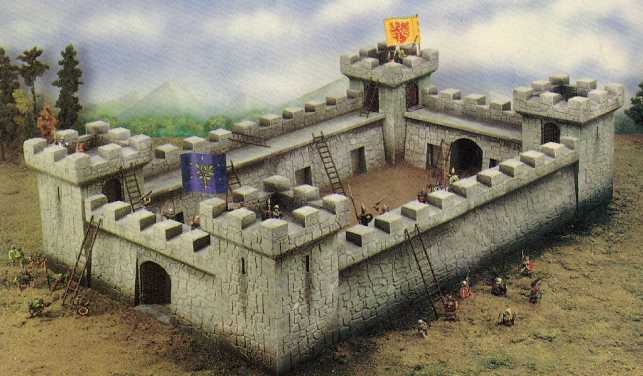
In the last article, we discussed the Mighty Fortress briefly, and I shared with you a number of pictures of it. If you recall, this was a gigantic polystyrene castle in different sections that came with a number of accessories; doors, flag poles etc. It's still a remarkable set, and well worth the £20 - £30 that you should expect to pay. It also has much more character than the later plastic beast that currently retails at £60 plus. 

As you'd expect, the launch article begins with an amusing tale or two. I don't know about you, but I never get tired of reading '80s tales of orcs, chaos warriors and grumpy dwarfs. It goes on to outline some of the rather complicated rules that can be found within this volume. Yeah, its essentially an ad, but it contains photographs that I would not have seen before when the magazine was published and it does look rather impressive. 

Here's a sight that should warm the cockles of any Oldhammerer. A huge table, thousands of painted, old school Citadel miniatures, a detailed, converted Mighty Fortress and a spanking '80s jumper on Priestley that would make Alan Partridge proud. 
So what does the book actually contain? Well its split into two real parts; the Fantasy Siege and Sieges in the 41st Millennium. Yes, that's right, one book that provides additional rules for TWO GW games; Rogue Trader and WFB3. The Fantasy Siege is the most detailed, and contains much material that with little effort could be converted for use in Rogue Trader, and it should be pointed out here that there was a clear, if not entirely successful, attempt to make RT, WFB and WFRP fairly compatible to each other during the time these rules were written. 
      In the early pages, you get a simple discussion about how to use your Mighty Fortress, or homemade castle, to create a stronghold, and a guide to the layout of castles in general to start. This is quite helpful, as it explains each part of the castle in game terms and helps fire your imagination for possible battles and sieges. This is followed with a rather complex article on Castle Maps, and the role of the GM in plotting the positions of hidden resources and forces. Awareness, concealment and and exposure are all buzzwords here. In my view, this is a rich vein for Oldhammer Fantasy players to tap. The opportunity to create and run a narrative based siege, perhaps taking place over several days, is a real possibility and would certainly be an experience. 
      Then we are into the rules proper. Beginning with movement, unit cohesion and travelling in unusual directions (up or down) are discussed and explained, all in exacting detail. There are even rules to dictate how troops move out of the castle! This is followed with a combat section, which provides additional rules to those already published in WFB3, including details on splitting units and adding fresh troops to a melee. How to retreat during a siege game is also covered. 
          Next, we have a fairly complex section detailing missile weapons. These cover everything from who is hit, to shooting at large monsters and those hiding behind the ramparts. In support of this, there are rules for the player to deal with structural damage as well as breaking down doors and gates. Fairly extensive don't you think? If that wasn't enough to encourage you to pack up your baggage and break off the siege, the next section details actual castle assaults by different means; namely ladders, grappling hooks, log rams and so forth. Don't panic if you prefer to be the defender! There are plenty of rules covering how to counter such attacks; mostly detailing dropped boulders or poured hot missiles. 
        Phew! 
        A new set of rules are given for use with large creatures and sieges. Fancy having a dragon attacking the wall, climbing the main tower and ripping off the roof to the keep? Yes, its all possible (and then some) in this rather inspiring section. Giants can even carry siege weapons for their smaller comrades! 

Proper art. And a proper man mangler too! Here's the famous 'Bryan Ansell's cigar' picture. 
A small section presents a ready to play example siege, entitled the Siege of Caraz-Lumbar and provides information about how to calculate who as actually won. The rest of the fantasy rule setdeals with the Strategic Map, which is used to 'role-play' other aspects of the siege, namely engines of war, baggage, constructing earthworks, mining (and counter-mining), using fire, starving out the opponent, magical weapons and so on. There really is so much material here that I feel exhausted just describing it! 
          Next up, we have the ruleset that provides additional support to Rogue Trader. Though the smaller of the two, you really do get some crazy RT ideas here. Sieges are split into three types; primitive, mixed and conventional (namely, sci-fitastic). For me, its the mixed sieges that provide the most interest. As I have written before, it is possible to design games where a lone space marine crash lands on a medieval world, pursued by a couple of traitor Rogue Traders. The space marine enlists the local human population to help him set up a homing beacon, while his enemies make a pact with the local orc tribes. Before you know it, you're fighting a fantasy siege with power armoured marines taking pot-shots and zany equiped Rogue Traders!
      Read on, and you'll uncover details of minefields, gravitron guns, mole mortars and much, much more. There are even rules for running a game where your castle is made out of some futuristic material that self heals! Brilliant! This section is rounded off with three different example castles to get your creative wargaming minds a-gurgling. 

Doesn't that top battlement shot just conjure a thousand narratives into your mind?
The art and the photography are what you'd expect to see in GW publications of this period, though there is a greater emphasis on personal collections of miniatures rather than studio models. Dave Andrews, stalwart of wargaming that he is, makes many an appearance here, and we get to see that many of his 80s historical models are used for much of the photography. Even Bryan Ansell's cigars make an cameo!

White Dwarf published a couple of articles that didn't make it into the final rulebook over the next few issues. I present one of those articles below. It concerns a few dirty tricks that a defender may use to help trounce the enemy. You'll find it below.

Sorry this one is a bit wonky!


Russ Nicholson and Paul Bonner's illustrations really help create an atmosphere.
Well, that was Warhammer Siege! It's quite a package and contains a great many excellent, and original ideas. Its certainly the most complex set of rules I have ever read detailing siege warfare, but it is essentially a toolkit rather than something to be adhered to religiously. 

Do you own a copy? Have you played a Siege game using these rules recently? Do you have any memories of playing with the ruleset 'back in the day'?

If so, please share below!

Orlygg.

Sunday, 24 February 2013

Acceptable in the 80s: Warhammer, The Mighty Fortress and WDs 100 and 101

     
Introduction
After all the interviews and articles concerning Slaves to Darkness and life at GW in the 80s, its exciting to return to the pages of Old School White Dwarf in search of more Warhammer Third Edition material. Today, its the Warhammer content from issues 100 and 101. 

The times are clearly a-changing, a fact not missed in the letter pages of these mighty magazine, with readers commenting that WD has rapidly become a 'house magazine' focusing on GW and Citadel products rather than pure roleplaying. But as we know now, sales of roleplaying games were in serious decline while sales of fantasy, and science fiction, wargames were rapidly on the rise. 

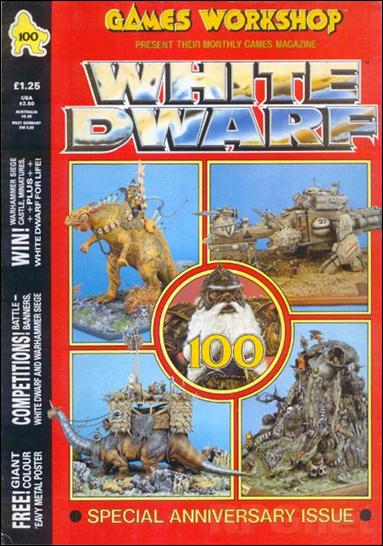
Issue 100 is, largely, a celebration of this past without actually providing much content dealing with traditional roleplaying. However, its does focus on fantasy modelling in a big way, and for the first time, miniatures appear on the front cover. Issue 101 sees the launch of 2nd edition Bloodbowl, with a great deal of pretty pictures and miniatures on show. The changes are increasingly clear by now, with no out of studio material at all, save the soon to be culled classifieds in the back of the magazine. The pattern of Warhammer releases follows its current downwards trend, with only a single advert (the wonderful Elf cavalry below) in 100 but major developments were just around the corner. Issue 101 sees more WFB content and details the iconic release of the Mighty Fortress, Citadel's polystyrene castle and makes reference to the first supplement to WFB3, the complex Warhammer Siege. 

I love the faint allusion to zebra strips on some of the horses, though its left to our imagination of these markings are natural to the breeds of elf horse or have been applied as some kind of warpaint. 
Elven Cavalry 
I much prefer the '80s look of the elves than the overblown po-faced designs of the 21st century. Here we have a series of mounted figures and a few spearmen. The models themselves are well proportioned and varied, with a mix between spear, sword and bow, providing the gamer with an opportunity to field units of each if they so desired. The tall helms and long chainmail coats have a faint middle eastern whiff about them and an effort has been made to sculpt horses that look different than the standard human one. These mounts are smaller and more graceful, much like their riders, though they are limited to two poses. This does effect the overall look of the models when seen together, as the advert above shows, as with skillful painting each horse can be made to look quite different. 

In my book, the Mighty Fortress is one of the greatest '80s releases. 
The Mighty Fortress
I always appreciated the fact that the Mighty Fortress was peddled to us as an accessory for both Warhammer and  Rogue Trader. I loved the idea of Medieval Worlds, where a few aliens could manipulate the masses and take power, only for some off world rivals to arrive and recruit local allies. The mix between RT and WFB rules was always exciting and varied. Best suited for skirmish games, narratives based on this simple premise are brilliant fun and were sadly missing from later editions. 
      So what did you get? A quick glance at the image below can provide more detail than I can express here, but basically, you got four towers, four wall sections and two gateway sections as well as loads of plastic doors, hatches and gateways. I'd always wanted one of these but lacked the funds back in the day, so a decent copy of the castle was one of the first purchases I made after I 'went retro' about two years ago. I remember the enormous package arriving in the back of a Royal Mail van and tearing the brown paper off with great excitement. The castle is very tactile. It feels light but solid and has the polystyrene familiarity that takes you straight back to toys and Christmases of old. Sure, there is better detailing today among plastic and resin castles, but the simple charm of this set compliments '80s models perfectly. The downside is, of course, the fragility of the castle itself. A hefty knock and the straight, even lines are characteristically, for polystyrene, damaged. However, this does make any conversions very simple to achieve.

One of the original adverts for the fortress, showing off the plastic components in a little more detail; ladders, doors, gateways and a flag pole or two. 

Dwarf Gyrocopter 
Zany inventions and crazy ideas were, and are, one of the major attractions for WFB3 era models and rulesets. If someone had a good idea for a model, it was usually made and some rules published alongside the release. The Gyrocopter is a lovely example of this. Sculpted by Mark Copplestone, the model is detailed and fantastic, but shares enough of real design to be believable. Its not a piece I know much about, not having and example in my own collection but I is certainly a model I'd be keen to own at the right price. 


The rules for this model were published in WD101 and are presented to you below along with a bit of background. They were written by Richard Halliwell and illustrated by Pete Knifton. One aspect of the models use in games is the fact that you can use a single model as a mount for a high level character. Fancy putting your dwarf general in one of these? I would if I had one.


So, we have moved from issue 93 to 101 and seen Warhammer: The Game of Fantasy Battles released and seen an abundance of new models, and re-released sculpts appear in the pages of White Dwarf. The game was about to see its first supplement release, Warhammer Siege, which would expand the gameplay of both WFB3 and Rogue Trader, as well as provided a reason for dropping your Mighty Fortress into your games.

We will discuss the book at length in our next discussion of what was 'Acceptable in the '80s.'

Orlygg.