Thursday, 31 March 2016

A Tale of Four Oldhammerers: March's Magician of Nurgle


Oh, what a month it has been. It all started out with this great plan for getting my bigger units finished for this project. After limping along in the race during the Tale of Four Oldhammer Gamers, I wanted to make more of a mad dash to the finish (this year's Oldhammer Weekend in August) and get so BIG units completed. Sadly, life as always intervened. So, a few days ago I finally admitted to myself that I was not going to get the two units of Nurgle I had wanted finished by the end of the month. 

But this left me a problem!

What could I submit if I only had a few days? 

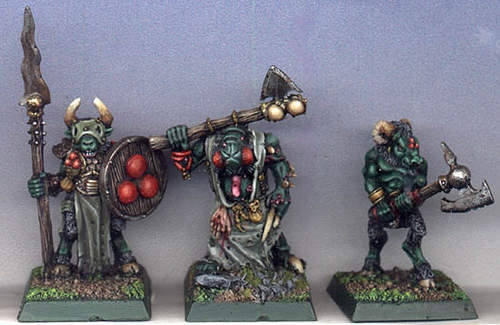
Thankfully chaos is very forgiving in a project like this and the necessary 100 points can easily be found by painting up a single champion model. But what model should I pick? I have a stack of the classic champions that Jes Goodwin designed in the late '80s and I even went as far as fishing their bag out of the Welsh Dresser. In the end though, I decided to paint something really, really special and I chose the model you can see here. 

Being close to the beating heart of Oldhammer, I have been lucky enough to meet a few collectors with some really nice pieces, and I have even managed to pick up a few of them too! Miniatures that were produced, but for many different reasons were never actually released. And this model is one of them. Perhaps you have seen it before on one of the CCM pages?

It has been referenced under 'Empire' and someone has suggested it represents a magician or druid. After painting it, I think that this assessment is not quite right. Judging by it's cadaverous visage (the face resembles a fleshy skull) I suspect that this model was once destined for a 'baddie' range. Having worked on it for a few hours, I feel that the model was never actually completed before casting. Parts of the figure seem unfinished and strangely empty. The 'robe' seems very, very smooth when compared to similar models from the 'era', almost as if additional detail were to be added later, but weren't. 


One thing that did strike me when I was preparing the model for painting were the three 'ball' shape pieces on the back. You can see them here in the image above. I have painted them a rusty silver. They don't appear to be grenades or pouches (you can see a pouch painted red below them) and are really rather inexplicable unless you look at the model from a chaos perspective. 

I feel that they are a Nurgle symbol, such as you see on many shields and models across the Citadel Range. Have a look here to see what I mean in more detail. The red shield clearly displays the classic symbol for the Plague God, doesn't it?

So this begs the question - could this be an unreleased Nurgle Magician instead? I believe so and it is for this reason I chose to paint him up for my (very slowly) growing old school Nurgle army. 

He was great fun to paint. The unfinished areas were suitably challenging and resulted in me having to be more creative with my painting. I had a little serendipity along the way too. As I was sticking the model to it's base, I managed to drip some superglue onto the figure's robe. In attempting to wipe it away I ended up sticking my fingers together and making a right old mess. However, the dried glue gave the robe a little irregular detail and instead of stripping it in the Nitro-Mors overnight (remember, I was on a time limit) I decided to just paint on over the dried glue. 

Can you notice? 

Recently, I unearthed a pot of Bilious Green in my storage area and decided to put the paint to one side to do something with. I haven't actually painted a model with the stuff for over twenty years and the challenge of doing so was a welcome one. You will have seen that I used this green to build up the skin tones with the final highlight being pure Bilious Green - a classic '80s clolour you just don't see any more. Bright red made up the eyes, a purple tongue and brown rotting teeth. The hair was also straightforwards - just grey, light grey and white painted in streaks. 

The robe was harder (not just because it had a crusty layer of superglue on it, either) as it was just so bland. It looked too smooth to be the fetid rags of a Nurgle follower. To solve this, I used a stippling effect with the paint while highlighting and created a rather wormy, irregular finish. A good glaze with a chestnut ink made the material look oily and damp. Nice and offensive like all good Nurgle follower's like to look! 

The staff was a throwback to an old undead army I painted in 2010. I used gold as a basecoat. Then washed over in a dark black ink. Once this was dry, I made a verdigris green wash out of blue and green and seeped this over the staff. Once this dried, the gold looked filthy and aged. I used the original base colour once again to highlight the edges of the metal. 

Bags, feathers and belts were painted quite simply with browns and blacks, as were the shoes. I used my prized Foundry Boneyard triad for the animal skull on the end of the staff. This really is a set of paints you NEED to own as they are absolutely excellent for painting bone. Finally, I used red and blue as spot colours for the pouch and dangling hair tuft below the animal skull - what are these called? 

All in all, I just scraped in with the time limit. Phew! I have been so busy I haven't even had a look at what the other boys in my Oldhammer gang have been up to this month, so I better go remedy that immediately! 

Orlygg

Thursday, 24 March 2016

The Unusual Suspects: Cleaning and identifying the figures


After a couple of days soaking in the Dettol, here they are! Five squeaky (almost) clean Warhammer models ready for an undercoat. But who are they? And from what ranges did they originate? 

The model on the far left is, of course, the miller figure from the C46 Villagers series which were released in July 1985. He is a fun little model though practically useless in an army building sense - as there are no weapons at all sculpted on the figure! Like many of the models in the range, he has been sculpted with a touch of the inbred yokel and wears very simple clothes. I do like the tiny details you can pick out of the grains inside the sack though. A model perfect for the front of any mill model. 

Jes the Poacher is up next. There are a number of variants based on this model, most notably Longbow who is also part of the Death on the Reik collection. 

The third model along is a rather snooty female from the Marauder Citizens range released in January 1989. Sadly, she lacks any kind of name save '10' carved in Roman numerals on her base. She looks fairly upmarket, for Warhammer anyway, and shall be painted as a posh lady. 

Behind her is Ruffler, a 1980s village thief sculpted in such a way as to suggest he is stuffing something rather dubious into his jerkin. What could it be? Perhaps a trinket lifted from the snooty lady we were just talking about?

Finally, we have the Citadel lawyer. Book in hand (a copy of WFB3, perhaps?) and no doubt eager to 'correct' your interpretation of the 'rules' at great length. Released as part of the C46 villagers set in November 1985. 

Each model presented me with a different set of challenges during the clean up. Both Jes and the Lawyer had very strange damage to their legs. They were missing their tabs and had there feet covered in a strange glue - possibly some kind of epoxy resin. I was able to chip the glue residue away from their shoes but both of their legs have been stained a strain grey colour. For a while I thought it might be leadrot bot the casting is still sound and strong. A mystery!

The lawyer has been undercoated in something black. It stained my hands for sometime after handling him. Yuck! What did people use to undercoat their models back then? Luckily, the Dettol stripped the black much away pretty quickly and I managed to clean the figure with the minimum of scrubbing. 

The miller was the easiest to clean. With just some tentative blobbings of brown on his sack (careful, Chico!) and I was able to brush most of this away with my thumb once the figure was removed from the Dettol. He shall have the honour of being the first model I will paint. 

Citizen '10' was a bitch. She was covered in a flaky, white undercoat that withstood even the power of Nitro-Mors to remove it. In the end, I had to chip away at the white paint with a cocktail stick and knife to unclog the detail. Ruffler was even worse. This thick, green sludge was adhering to much of the model's detail and after while I released that the filth was Greenstuff! Almost as if a greenstuffy finger had once plucked the model off the tabletop and squeezed it's cargo deep into the model's detail! 

Next step - undercoats! 

Tuesday, 22 March 2016

The Unusual Suspects: Restoring pre-owned Citadel Miniatures


With the Easter holidays fast approaching, it is nice to be able to plan out some welcome hobby projects. I have already based up some choice units for the Tale of Four Oldhammer Gamers (more about them soon) and my McDeath project remains an ongoing concern. 

But before I dive into those, I want to take a look at the humble battered Citadel figure - very much like the five you can see here today. It seems to me that a great deal of effort is put into the acquisition of near mint lead. I hear talk of 'perfect castings' and 'never painted' all of the time. I am sure that many collectors get a great deal of satisfaction from locating desirable miniatures in mint and near-mint condition. 

Collecting things is a buzz after all. And I can honestly say that I have been guilty once or twice in the past of focusing a little too much on the rare or pristine stuff, especially when you consider that most classic Warhammer figures are in a pretty shoddy state indeed.  Dented, squashed and hideously painted - models like this must exist everywhere and it seems for many, just not worth the effort to strip and reuse. They reside, like forgotten children, at the bottom of every grognard's leadpile - ignored and unloved.

I adore restoring them. Cleaning away the years of abuse, tending to their damaged limbs or weapons and finally painting them up so once again, they can be part of a display or game. Over the next few posts, I will be chronicling my efforts to breathe new life into these battered models. By Sunday, I hope to have all five of these models complete and ready for the table top. 

An early Easter painting challenge if you will. But first, to strip them of decades of decadence and remove all of that clinging paint. 

So, to the Dettol they must go! 


Sunday, 20 March 2016

McDeath: Een McWrecker

Een McWrecker stands alongside the Rough Inn at Winwood Harbour. As one of McDeath's most trusted underlings, McWreck spent many days dealing with the clansmen under his master's control. The McArnos were no exception. 
It has been some months I know but today marks the day I am officially back on my McDeath project. Een McWrecker stands complete after nearly a year on my paintstation! As before, I opted to follow the colour scheme used on the original cardboard cut outs in the McDeath supplement, giving him a spanking red hat, brown breeches and a pea-green jacket.

I didn't faff around painting but threw myself full force into my speed painting techniques. I am particularly pleased with his face, and I created the sense of depth you can see in the photograph using dark brown and black inks before highlighting. As with many of the wizards released in the mid 1980s (Een McWrecker is not a limited figure, and was available in other ranges) he has a number of little irreverent details about his person. A broad bladed steel knife hangs at his hip for starters and a curious 'rosary' dangles from his raised wrist. I liked the fact that the raised hand has been sculpted in such as way as to suggest he is in the middle of an incantation. You cannot see the detail in these photographs, but the golden bowl he is holding has been sculpted in such a way to suggest it holds burning coals. I used black, reds, orange, yellow and white to paint on burning coals inside the vessel. 

Salty porridge is a virtue in the wild north of Albion. Sadly, not so for McWrecker's digestion. After consuming some of the McArno's fare he was forced to make a hasty exit towards the privy. 
More details appear on the reverse of the model - including a telescope! His hat intrigues me the most though, for he has some kind of 'lump' sitting on his hat and I didn't have the foggiest what it was supposed to represent. In the end, I painted it as a candle (complete with running wax and wick) stuffed on top of his wide brimmed hat. Well, how else would he see I suppose?

Have any other Oldhammerers taken on this wizard? If so, how did you interpret the strange lump?

Orlygg

A hurried snap of my painted McDeath collection. I will try and do better next time...

Saturday, 19 March 2016

Original Astrogranite?


I have always been rather puzzled by this initial shot of the famous 'astrogranite' Bloodbowl pitch which arrived with the second edition of the game. It doesn't look right does it? There is something different about the pitch seen here and the one we all played on for so many years thereafter.

Strange, isn't it?

The image above is taken from White Dwarf 101 and in many ways that edition of the magazine served as a 'launch issue' for the game. The iconic '80s artwork adorned the front cover of the mag, just like it did the big box, and inside the pages were a number of irreverent articles in support of the new game. 

I have already mentioned the 'Big Box' era of games and Bloodbowl was the very first. I find it hard to explain to younger gamers how exciting this period of GW history was. Everything was new... you were never really sure what was around the corner. Sadly, the last 25 years or so has not really been about innovation but repetition, and many have taken it for granted that such a wealth (in production or not) of GW games existed! 

Think about it! Bloodbowl, Dark Future, Space Marine, Adeptus Titanicus. Advanced Space Crusade, Advanced Heroquest.... The games seemed endless. And the excitement of purchasing one of these games was incredible. The weight of the box. That smell that opening the lid for the first time unleashed. The joy of seeing row upon row of mint plastic miniatures on sprues, card counters and playing surfaces. 

Bloodbowl's pitch was the ultimate though. For those of you who don't know, the pitch came in three sections. A middle (with a nifty skull design and Bloodbowl logo) and two identical 'ends' the completed the piece - there was even space for you to add your laminated card team colours! All in a milky grey polystyrene material.

Here's an extract from one of the '80s ads for the game.


Now compare the two boards. They really are quite different are they not? The original is more streamlined, less bulky and lacks the cracked stone paving around the edges. If you peer closely at the circular blow ups on the first image you can also see that the iconic Bloodbowl design in the centre of the pitch has simply been painted on.

In truth, they are utterly different!

You are probably thinking 'how on earth did I not notice that over the last (nearly) 30 years'? Well don't worry, I have been researching, collecting and writing about old school Games Workshop for nearly five years... and I didn't notice it either!! If it hadn't been for our friend Darren Matthews mentioning it in passing, I doubt we would have ever known.

Here is what Darren had to say:

DM: One little thing that I have remembered is that the very first Bloodbowl board used in the advert in White Dwarf was made out of... wood! I had to spend over two days trying it to resemble the polystyrene foam that was going to be included in the boxed game... I loathed having to paint it and I was never a fan of the game or it's miniatures afterwards! 
As the saying goes - you learn something new everyday! And today we discovered that the very first brutal tackles carried out in Bloodbowl second edition were on MDF, rather than the legendary 'astrogranite'!

I asked if he could recall who built the original wooden board for the game. I suspected Trish Morrison but this was just a hunch based on the fact that Bryan Ansell has since told me she built the first Mighty Fortress model out of, yes you guessed it, wood! 

DM: I don't remember who made the first Bloodbowl pitch, but Phil Lewis dumped the project on me after he had become frustrated with painting it. I had start all over again... repainting Phil's work with my own. In the end I think it took about six different coats and shades until management where happy with it. One of those 'advertising production nightmares' no-one ever finds out about! 


I asked if he could remember any other 'challenging assignments' that would match the original Bloodbowl pitch in difficulty.

DM: I remember Sid (the mysterious 'Evey Metal painter) throwing the very first Juggernaut of Khorne in the bin for being too insulting for us to paint. He said that it looked 'worse than Battle Cat from He-Man'! We all nearly died from laughing but were told off by our managers. It did stay in the bin though, for about five hours until I relented and removed it to work on. Later on, a second version of the Khorne Juggernaut arrived in the Studio and we painters all drew straws to see who would have to paint it! Everyone hated that figure in the studio and it wasn't often we received something we didn't like.


And here is the earliest Khorne Juggernaut I could find in a Games Workshop publication and one that Darren confirmed was one of his. Whether it was the unfortunate model that ended up in the bin I guess we will never know. One intriguing question does raise it's head here, though...

We all know that there are unreleased 'prototype' Beasts of Nurgle. Could there be 'prototype' Juggernauts of Khorne out there waiting to be discovered too? 

Perhaps the Nuln Spearman is riding one?

Orlygg


Sunday, 13 March 2016

Behind the Scenes at Citadel Miniatures: Darren Matthew's Photographs

Photograph A
One of our heroes, ex- '80s 'Eavy Metaller Darren Matthews, recently shared a few snaps of himself at work in the Nottingham Games Workshop store during one of those famous 'Painting Demonstrations' they used to do. 

I knew as soon as I saw these on Facebook that readers of this blog would be interested in them, especially those of your who do not frequent that particular social media site. It has long been my policy to share little nuggets like this, partly to ensure that the wider community gets to see them but to also preserve them for prosperity. Facebook feeds disappear quickly! 

I have provided a little bit of a commentary for each photograph. 

Photograph A: The first thing that strikes me here is the fact that Darren is holding a second brush in his mouth. I asked him about this (as I can recall seeing a lot of the '80s painters doing this) and he quite an interesting story to tell. 

DM: The brush in the mouth was for quick blending when we were painting fast, and in the end it became a habit. This was before wet palettes were used and blending was required on a model. The studio was always very warm and so paint dried very fast. It also helped when you were using a larger brush to have a finer point ready to neaten up details, or have a second brush ready with the highlight to run into the area you needed to blend. Some days when you had six or seven figures to paint, you have to become very fast!

The case is also very interesting. It strongly resembles the box in which John Blanche's famous undead diorama sits in. Viewed for the side, you can see that cuboid blocks of what looks like polystyrene have been placed on top of each other and covered over with the paper backed 'grass' we all used to use back then. On top you can see the famous Nurgle Rhino - which I located in one of Bryan Ansell's cabinets not so long ago - only here you can see that there were once many more nurglings on the top than there are now. It is hard to make out what else is in the cabinet from this angle - a Space Wolves predator tank can also be seen perched on the top, with a titan in between the two larger models.

Of course, if you look behind Darren and have a glance at the stock in the store it is enough to make the collector in me weep. Rows of mint Warhammer Third edition books, Warhammer Armies and Townscape!! If you look carefully, you can see that there are also a row of comics on sale which all have a rather un-GW look about them!

My photograph of Darren's rhino - is it me, or are there not so many nurglings left?
Photograph B
Photograph B: Here we get a better shot of Darren and can see more of the store and that interesting miniature case. When I spoke to Darren, I asked about all of the models in the display case. They are all his own work. If you look closely you can see some very well known painted examples, including the famous red Ork Nob in power armour, the Bob Olley ogre and one of the original Bloodbowl star players. He went on to say that the Space Wolf predator tank on top was the original prototype model kit. The 'first' ever predator if you like. 

The rather obnoxious posters advertise some of the other painters in the 'Eavy Metal team at that time. The well known Ivan Bartleet (where IS he now?) and Rich Hodgkinson. Sadly, I never got the chance to visit a GW store when one of the resident painters were in and often wondered what went on. Having seen many of the models on display in that cabinet at Stoke Hall I can well imagine the excitement a visitor would feel coming face to face with models they had been gawping at for years!!

Having a look at the murky world of the store reveals more impossible treasure. The complete run of WFRP bar Empire in Flames, plastic Imperial Guard in the miniature display case and the bottom rungs of the blister wall! 

Photograph C
Photograph C: This picture is the most fascinating of all. It was taken inside the famous Games Workshop design studio during development of the Adeptus Titanicus game and shows a very rare 'work in progress' shot of a late '80s game system. I asked Darren about what he could recall of this project.

DM: I cannot remember what did or didn't end up in the final game, as development was ongoing by the time I left the company. The large mock up white landship things never made it into production and I think Tony Cottrell was behind them. The Rhinos and Land Raiders in the picture were changed as they damaged the moulds and the final product ended up looking more simple than first imagined. I know a lot of the terrain was totally scratch built from all sorts of different materials and household junk. A real 'Blue Peter' effort went into it and I made small bits of it and Tony built the rest. 

You can see many of the famous painted titans later published in White Dwarf in this shot. Steve Casey published a detailed blog post about them some year ago. Check out the link here. I love being able to see them as work in progresses too. Try comparing the miniatures you can see in this photograph with the models you can see in the 'Eavy Metal article below. 


Of course, the biggest puzzle are those large 'grav' tank models. If you look, you can see that there are clear gun emplacements and that troops seem to be 'hitching a ride' on them. What were they made from? I am no expert but the casts look like plaster to me. More importantly, what exactly were they supposed to be? And how would they have been incorporated into the game? Perhaps they are not tanks at all, but buttresses or forts? 

If anyone from the studio back then is reading this - we would love to know!

With the talk of genestealer cults popular once more, I shall leave this little article with this lovely scan from an old White Dwarf. It is one of the genestealer hybrids that Darren painted in the late '80s. 

Gorgeous isn't it?


Big thanks to Darren Matthews. If you haven't already done so, go read the interview I did with him a few months ago.

http://realmofchaos80s.blogspot.co.uk/2015/10/the-harlequin-interview-with-darren.html

Saturday, 12 March 2016

Pantheon of Chaos: Son of Zygor, a Chaos Warrior, Thug and a WIP Beast of Malal


Diego contacted me last Saturday to say he had some more greens to share with you all. Funnily enough, I was just strolling out of Stoke Hall's stableyard as he did so (an exciting mix of old and new there) though it has taken him until now to send things through to me.

And the wait has been more than worth it. 

I think what most excites me about this project is the way Diego and the team continuously surprise and amaze me. This time, it was with the incredible Zz'anDor, the son of Zygor, green you can see at the top of the blog post. It is beautifully executed in a style that meshes both old and new. 

A 'must have' must have model!


Next up, this fully fledged chaos warrior by Christen. The armour is really in keeping with the older mid '80s models - based on actual suits of armour- with that little twist of evil thrown in. It is easy to miss, so check out the detail on the feet! No boots but malformed toes! A fantastic touch. 


Beautiful sculpting shown on the reverse of the model and that fur detail is just screaming out to be painted. I also like the way the cloak resembles flayed skin. Ghoulish! 


Christian has also finished work on this female thug. Now there IS a rarity. If you read my blogpost about women in Warhammer you will know that one of my bugbears is a lack of realistic looking female figures in the Games Workshop ranges. This lass looks like she means business and is quite sensibly attired for life in the Chaos Realms. The ornate armour and raised mutated crab claw are nice touches. 

Slaanesh anyone?


I think the addition of a hex base really ramps up the look of this particular model - don't you think?


And finally, one you have probably been all waiting for! A WIP of the Beast of Malal concept. Personally, I would have spread the legs out a little bit so the limbs look a little more splayed but I expect that this will be a multi-part model in the end, so we needn't worry. 

Repulsive isn't it? In a good way. I have been really impressed by how the Pantheon of Chaos team have managed to capture the horrific creations of Tony Ackland and bring them alive in greenstuff. 

More news on this project as we get it! 

Orlygg