Showing posts with label Dwarfs. Show all posts

Friday, 20 March 2015

McDeath: Arka Zargul


I have discovered the joy of 1980s dwarf miniatures. They are just such fun to paint. Arka Zargul, a dwarf with a wonderfully punny name if you know anything about '80s British political history, is the latest addition to my ever growing McDeath range. And if you hadn't worked it out already, I really enjoyed working on him.

Of course, old Arka isn't a rare, specially made model exclusively designed for McDeath! Oh no! More of a Norse dwarf imposter, actually - but that doesn't stop many people trying to flog him off at a frankly ludicrous price.

Talking of ludicrous prices - at a recent Oldhammer event I took this snap of a couple of my clansmen alongside the infamous Dragon Turtle monster from Citadel. As with Arka, this was never a 'limited' model and was available for many, many years but you can find several online sellers trying to overcharge you for him....

I wonder how many rash collectors have been disappointed by his... ahem... size?


Wednesday, 18 March 2015

Acceptable in the '80s: Wayne England's Dwarf Army: Part Two


Last month, I posted an article about Wayne England's seminal Dwarf Longbeard force here on the RoC80s. If you missed that post, or are keen to read it once more, it can be found by following this link. Now Wayne's ears must be burning once more as I have heard from the Wargames Foundry that there is a very good chance that he may be attending the event on the 1st and 2nd of August. I have a little rudimentary post set up detailing this years extravaganza already, and shortly I shall be updating it with this exciting news and moving it to my pages section on this blog. 

In celebration of the news, I have tracked down the further reference to this very early '90s force from across the expanse of the internet (ie - followed the links I was sent by other fans) and have shared them here once more. The images shown here come from issues 144 and 148 of White Dwarf, so right from the end of our Third Edition period, and are really an enjoyable read if you are a fan of these models. 

So let's have a look at things in detail, shall we?


First up we have this new unit of clansmen with absolutely excellent shields. The white and black contrast on this iconography works extremely well and is ultimately highly inspiring. You may also notice a clever conversion or two, most notably the dwarf siege weapon crewman with this large spear replaced with the pole of a standard. A very simple conversion to execute on a model that is still extremely easy and cheap to get hold of. I shall be trying that one at some point for sure. Something else worth considering here before I move on is the presence of TWO standards in the single unit. This I really like and will again be stealing this idea. The thought that units would only wave one banner is rather silly now that I think about it. The more the merrier!!


This page chronicles the force in a little more detail and shares with us a rather rare sight, even in the glory days of '80s Warhammer: a dwarf wizard! Now many of you will know that the short ones were not famed for their magic casting prowess, preferring to excel underground with mining and tunnelling. If you scan through the simple list here you can get some idea about how Mr. England was structuring his force. Its nice to see a well painted version of the dwarf bolt thrower too!


The original article goes on to share so detail about how the units seen here were put together and include a marvellously painted unit of Marauder spearmen. As we know, these are some of the finest dwarf models produced by anyone anywhere - and its fantastic to see them painted up so well and in Wayne's collection. What you will probably have noticed that the colour scheme has changed from blue, white and black once more. This time green is the scene!


This colour scheme trend continues with this page published (I believe) in White Dwarf 148. Here we can see that old stalwart the Dwarf Flame cannon in league with a Bretonnian cannon to give this dwarf army a little more punch. 

And to leave you... Two images (again from WD 144 and 148) showing Wayne's army in action - back in the days when the Warhammer World had reasonable looking trees!


Sunday, 1 February 2015

Acceptable in the '80s: Wayne England's Dwarf Longbeards


We draw near to the end of my long series of posts chronicling the history of Warhammer Third Edition. Our gaze must now fall upon White Dwarf 135, which was the last issue I bought if memory serves, as I switched back to Zzap!64, and later Amiga Power.

Warhammer coverage had been in decline for some time and this was a trend that wouldn't reverse until the publication of Fourth Edition in issue 150. We also now know that Bryan took nearly the entire painted collection of '80s style miniatures with him when he left and you will notice that older Studio miniatures do not occur very often from this point onwards. Even Marauder, long the 'official' designer of Warhammer miniatures, reduced their output in the magazine to 'army deals' rather than new releases around this time, though regular releases would return.


Still, there was to be a last hurrah for the edition in the coming year. A series of articles that many of us remember fondly and of which are still much discussed. Instead of new models and background, we got to see (for pretty much the first time) the actual armies of GW stalwarts published in the monthly mag. 

The first, and perhaps the most well known, were Wayne England's Longbeards.


What is interesting about this article, is it mentions some of the armies that were kicking around the Studio at the time. We can infer that these are most likely personal forces rather than the official armies we grew used to in later years. Stephen Tappin, the artist whose work we looked at a few posts back, crops up as contributor to the huge dwarf army that was being planned, but to my knowledge, this is the only time we get to actually see any of the miniatures.

The unit looks spectacular, and just goes to show how far some very simple techniques can take someone with artistic flair. The beautifully designed Perry dwarfs help too. When each sculpt is an individual character and not an identikit clone, the resulting unit feels much more like a swirling mass of boozy stunties and looks superb when photographed.

I love the sense of movement on the converted standard bearer too! 


Reading through the text, its evident that Wayne wanted to get a lot of miniatures painted up quickly and wasn't too concerned with winning a Golden Demon. In fact, you get a crash course in how to quickly paint up a great number of models and get them on to the the table, fast. 

If Helen of Troy was the face that launched a thousand ships, I really do wonder if this article launched a large number of dwarf armies. Though they were most likely not as beautiful as Helen, I am sure that in the eyes of their owners, they were every bit as remarkable. 


Saturday, 31 January 2015

Colin Dixon and Roy Eastland's Miniature Ranges from White Dwarf 133


As the festivities of the Christmas period in 1990 drew to their reluctant end, Games Workshop published their regular magazine on a very expecting world. As many of you will remember, White Dwarf was a very needed 'hobby-injection' in a world of print media. Its easy to take access to such material for granted these days (especially when you think there is probably more content published each month online for classic GW games than there was back in 1990) but back then, picking up a copy (or even better, getting your mag in the post) was an exciting event. 

For me, I'd grab my copy (as I did with issue 133) and dash up the stairs to my bedroom ready to absorb its contents over an hour or so. My first port of call was always the 'Eavy Metal pages - as they were of course in colour - and I would continue my endless pondering over why my painted miniatures didn't look as good as those in the magazine. 


However, this month had a little bit of a surprise in store for the GW fan. After years of collecting and gaming with Warhammer, Heroquest and the like, the sculpting team at Citadel were most definitely household (or should I say classroom?) names in my life. In January 1991 two new masters of the putty emerged: Roy Eastland and Colin Dixon.

Eastland's techs are a fairly so-so group of miniatures with rather static poses - though in their defence, this may well be due to the need to include the plastic arms and weapons of the time. I have never been a huge fan of uniformity in miniature design and these techs seem a little too similar for my painting tastes. I would probably give them a miss if I considered collecting the Confrontation ranges. On the other hand, the bounty hunters are excellent examples of 40k related material in the early 1990s, being varied, ragged cyberpunks! They really do look like the characters seen in the Confrontation artwork realised in lead. I would love some of these, but I suspect that so would many others and getting them for a reasonable price would take some time indeed!


Eastland's skeletons are excellent and are easily some of the finest ever cast up by Citadel. Here there is a great deal more room for variation of pose and this really helps bring the models to life. You see these turn up quite regularly on Facebook with collectors asking if they were part of the GW ranges, most likely because they don't appear in many of the catalogues available online. They are also really well painted and the colours selected convey the skeletal menace of these troops wonderfully.


The dwarfs, though characterful, are not as successful as the skeletons. They are still solid models that will easily stand alongside the numerous others produced in the 1980s, but there is something about them that seems lacking. I really do like the first model (from the left) and the third model as they share an Alpine quality similar to the dwarf skiier we have discussed in the past. 


Interestingly, the models were supported with a rather interesting little article about the two sculptors. Colin's biography is probably well known to long term readers of this blog and others that deal with classic GW material. He was the ORIGINAL 'Eavy Metal painter and was first person to be employed by GW to paint full time.  Roy Eastland is a name that doesn't ring any further bells with me, but I think he went on to produce figures for a number of other manufacturers in the 1990s. 

Anyone know anymore?

If we time travel back to my bedroom of yesteryear, I can recall quite clearly really wanting to get hold of the skeleton models to help bolster my plastic force. Sadly, I never got the opportunity and I don't really recall ever being able to find these models dangling from the blister rack at Wonderworld. I have the beginnings of a twenty-first century undead army on my display case, though its a project I have't worked on for a while, one day I shall and I think I would very much like to include these skeletons in it, perhaps as character models. 

Any fans of these models out there?

Orlygg

Sunday, 27 July 2014

Acceptable in the '80s: Marauder Releases from White Dwarf 120 and 121


With the weather being so hot at the time of writing, I have found it hard to do little but laze about on my holidays and cook tasty meals for my family. Oldhammer related work has ground to a halt. Things seem a little cooler today, so I am back at the desk, though my goal at the moment is review the next releases of Marauder miniatures rather than wield the paint brush. Right then, where are we in this journey through Warhammer Third Edition? These releases featured in White Dwarf 120 and 121 and saw the introduction to something that got many of us fantasy nuts drooling - Marauder regiment and army deals. 

Issue 120 saw the arrival of some more Dark Elves into the range, or more precisely, Witch Elves. I find these models rather chunky and frankly, rather manly. The Bob Naismith Dark Elves are much better in my opinion, and far more lithe. I traded some away a few days ago to Stuart and am now lamenting their loss. Still, their absence from the collection just gives an excuse to buy some more in the future. The paintjobs are little better and have a distinct whiff of the 'Red Period' of painting that followed the 'Classic' Bryan Ansell years. 

Things improve further down the page with a second visit to the incredible Marauder dwarfs. I have written about these before and I have stated that they are probably the greatest dwarfs ever cast. My opinion hasn't changed since my last visit to the models and the standard bearer is a thing of beauty, both for the actual sculpting and its exquisite paint job. In fact, the entire command range are practically perfect and shame the entire modern dwarf line all the way to the headmistress' office. 

Finally, we have the Orc stone thrower. Considering they are not by Kev Adams, these greenskins are really rather good, though shades of the Man Mangler remain. I would be happy to own this model and paint it up for my Goblinoid army, as I expect would many of you. 


It being the very late 1980s at this point, colour photographs in magazines were still expensive and black and white was still used extensively- its funny what you forget, isn't it? Sadly, we have no photographs of the remaining Witch Elves, nor the goblin regiment but what we do have is an intriguing reminder of the Marauder Blade painting competition. Its often forgotten these days and I wonder what happened to all those blades?


And so we are on to White Dwarf 121 and the first army deal from Marauder. I loved these as a youngest for two reasons. One, the painted models. Two, the background context that the army was put in. Many of the models on show here were previously shown only as line drawing and its fantastic to see many of them, even though some of obscured in the second rank. Two models here catch my eye as being worth a mention, namely the Deathcap Hero (in a classic pose for a single cast model) and the brilliant standard bearer. 


And here is the rest of the force. Gorgeous when arrayed together. The perfect mix of riotous colour and conformity which, perhaps rather surprisingly, works as a whole. Of note here are the excellent Marauder shields, which are a mixture of freehand designs and painted cast patterns. The price is enough to make you weep all these years later, £50 for 78 Dark Elves, 4 Warhounds and a FREE Darklord and Deathdealer on Cold Ones. I for one, recall pouring over this article and vainly attempting to construct a plan that would see me having £50 to spend on them. I failed, as I expect did many of you! Still, it just goes to show, GW did once do deals.  


A simple army list has been included at the end of the article along with an intriguing ad for Abandon Art. These days Fantasy and Science Fiction tropes have become rather mainstream, especially in the world of computer games and have in many cases become rather generic. One bald 'Space Marine' looks much like another in games like Mass Effect, Gear of War and so on. Fantasy has had a similar fate, though there have been exceptions, like the startling original world of Morrowind in the Elder Scrolls series. Adverts like this remind us that back in the later '80s Fantasy was much less mainstream as it is now and subsequently was treated a little more seriously. A quick glance at some of the artists involved is impressive and I would certainly love to walk through the gallery to this day! 


The final image shows off the Warhounds in further detail. I haven't got much to say about them really apart from pointing out that the dogs do look a little 'cute'. When compared with the Troll Slayers you can catch another whiff of the 'Red Period' with the dominance of that shade, and its cousins, in the paint schemes. I rather like the Troll Slayers, don't you?

What is interesting is that the Painting Competition I mentioned earlier seems to have been renamed in the past month. Its now the 1990 marauder Blade Painting Competition. It sounds MUCH more impressive doesn't it. I wonder who won it and what the winning entry was? 

Anyone know out there?

Orlygg

Monday, 16 June 2014

Acceptable in the '80s: Marauder Miniatures' Chaos Dwarfs and Dwarf Regiment


White Dwarf 117 contains little that would interest the hardcore Warhammer Fantasy battler. Rogue Trader and the big box games dominate the proceedings entirely. Then two pages of brightly coloured miniatures draw the eye and reveal two ranges of miniatures that would become some of the most collectible from any period before or since. 

The Marauder chaos dwarfs and the dwarf regiment!

Now what makes the chaos dwarfs even more remarkable is the fact that they are little tributes to the earlier chaos warrior range from about 1985, the one with the Slambo miniature in. Can you spot the model that apes his design in the photograph above? These models are great fun and fit in very closely with the scale and themes of previous Citadel stunties. Beware if you want to set about collecting these as I have seen one or two of them reach quite high prices for chaos dwarfs, though they are all pretty readily available on online auction sites. It is also worthy of noting the colour schemes given here as I feel the tones chosen are top notch and there is a great deal of inspiration here for any enthusiast attempting to paint up any heavily armed chaos warriors, thugs or dwarfs. 

I have yet to begin collecting Marauder in any great amount but a set of these lovely models will be at the top of my list when I begin doing so. 


Oh, how I remember this regiment! I can recall loving these for the moment I flicked through the pages of this WD and planned how I could possibly afford them on £5 a month pocket money. I can recall searching under the beds and behind the sofa to amass enough to get my hands on these. The pitiful collection of copper pennies I unearthed wouldn't even have paid the postage and to this day I still haven't managed to get hold of any of these. Probably because everyone else is after them too!

I am happy to go out on a limb and say that this collection is probably the best range of dwarfs ever produced, with the command models worthy of particular praise. So full of character and little detail, these models seem to breathe life to the paint that is adhered upon them. They are just excellent, excellent, excellent! The two ranges at the bottom of the page, in the glory days of ordering whatever you could, allowed you to create whole regiments of greatswords, halbardiers and musketeers. A very well thought out range this. Which just goes to show why they are still so popular twenty-five years later. 

I am envious of anyone of you fellow enthusiasts who owns a collection of these! Do these wonderful models have any more fans out there? If so, please share you thoughts on them in the usual way! 

Orlygg

Saturday, 29 March 2014

Acceptable in the '80s: Marauder Dwarf War Machines, Marauder Wood Elves and Bretonnian Knights


Last time we spoke about the history of Warhammer Fantasy Battle Third Edition we took a little sidestep to have a look at the way Heroquest was launched. Over the coming months, there were several articles published for the game and more complex scenarios were provided for Advanced Heroquest. The astonishing success of the game helped encourage the company's future owners to concentrate on the younger market.

'Our Warhammer' still had a number of years to exist though, before 3rd edition made way for the radical change that was 4th, though it is worth remembering that The Lost and the Damned remained as a major supplement still in development. As I have said before, true Warhammer III articles were very much in decline though the later part of '89 and into the 1990s. Even the miniature releases slowed. However, Marauder Miniatures began to produce more and more Warhammer Third Edition army sets and started publishing them as army deals. I am sure that many readers of this blog who purchased White Dwarf during this period will remember the full colour adverts for these.

By issue 115, Marauder had been going strong for quite some time (around two years) and subsequently had a lot of models to release. I know, from Andy Craig, that the models that Marauder produced were painted by the 'Eavy Metal team as a favour to Aly and Trish Morrison. However, not all the models that Marauder produced were photographed in these adverts. The stalwart of 1980s advertising, the line drawn image, was used to illustrate some ranges, while photographs were used for others.

The releases from 115 concerned Dwarf War Machines and Wood Elves. So without any more waffle, let's have a look at them.  


At the time I loved the Marauder dwarf range. In later years, I began to loathe the models as they represented, to me anyway, the awful 'big hands oversized weapons' era of Citadel Miniatures. A lot of the blame was put on the step of Marauder, but after years of study and discussions with interested and involved parties I have come to really appreciate this range once more. The late-Medieval look was a great choice for the tone of the models and moved away from the Viking style stunties we had seen in the past. The faces were packed with character, vital for a dwarf in my opinion, and some of the better models tell their own little tales in 28mm. This page reveals to the world some of the siege engines that the dwarfs could field, namely the Organ, Siege and Swivel Guns, listed here with nostalgic prices when compared to today's collectors market. 

These models are well worth owning of you are a fan of Citadel or Marauder or indeed both. Especially if you have the spearmen as well. One day I have promised myself I'd work on a dwarf army of considerable size, and these models will be some of the first I will be chasing. 


The Wood Elves did not get so lucky. They were lumbered with this month's line drawn adverts. I actually own a few of the Marauder wood elves but I cannot recognise mine among these, so perhaps there were other releases. Not much can really be drawn from the images as its hard to appraise miniatures through drawings alone. I pick up a faint 'native American' vibe going on here, don't you? Something about some of the hairstyles and clothing reminds me of the really bad westerns that used to play on Sunday afternoons during the late '80s. 


The final miniature release relating to Warhammer Third Edition in WD 115 are these wonderful Bretonnian knights, designed to make use of the new Citadel plastic horse. These models are really much larger than many miniatures Citadel released during 1988 and are in some cases twice the size of the old 'Baron's War' range that served as the Sons of Breton for so many years. I think this size increase may have more to do with the limits of plastic casting technology at the time rather than any conscious effort to make things larger, but that is just my opinion. 

Having a glance over the models, you can see that the Perry's have produced another solid set of models here. What else would you expect? They have always produced solid sets of models. This are far more 'historical' looking that what would come later in 4th edition and I have always wondered if the historical market was in mind when these were originally produced. I have a number of these models kicking about and they are lovely to paint. I expect that a great number of these models still see service in historical armies to this day, explaining why some of them reach very high prices on eBay. 

What are your thoughts on the models discussed today?

Orlygg

Sunday, 23 February 2014

Acceptable in the '80s: Dwarf Ski Troops from White Dwarf 116


Three things have inspired me to post today. 1) The grind of writing school reports - yes its that time of year in my house and I sit here with still 10,000 words to write and two days left to complete the job. So switching topic and doing some blogging is welcome release. 2) Because Jamie Loft is building a new dwarf army over on the Oldhammer Facebook Group. 3) I have lost another auction to win one of these beauties! 

I have said before that Warhammer Fantasy Battle was a victim of the success of 40k. And the terrible slide that we can see today, actually began in 1987 when the number one fantasy wargame was replaced by one involving space marines. The amount of WFB material dropped away in WD, but there were still some stunning articles that saw the light of day and this was one of them. 

I have always loved this model, and it seems that many others do to as, though the are not uncommon on eBay, that can fetch a relatively high price (about £20 seems to be the average in my experience). They are wondefully characterful, as is much of the '80s dwarf output, and have some interesting rules too. Really, they are perfect for a little conversion project as any suitably well dressed dwarf could have the tab cut away and home made skis attached! 

Not as nice as having the original mode though. 

Anyway, here are the rules. Its about time I got cracking on with the rest of this series but with everything else going on in Orlygg's life and other directions pulling at me its hard to focus on the rather tedious job of scanning documents. 

So enjoy them. 


The rules are fun, as you will have seen. Considering that this is just a one page hit to help promote a model the content is very good. You get a nice piece of fluff concerning the mountain ranges of the Od World. There there is the 'ski charge'! How cinematic would that be, eh? If you could get your hands on enough of the models! Imagine the painted models, in Swedish knitted style, hurtling down the mountain side into the flank of some lost goblins or orks! 

Then you could let loose with perhaps the greatest special rule of Warhammer Fantasy Battle Third Edition (or indeed any edition before or since) the Yodel of Doom! 

Brilliance!

And if anyone has a spare Dwarf Mountaineer for me just drop me a line and contact me at realmofchaos80s@yahoo.co.uk 

Cheers!

Orlygg

Sunday, 8 December 2013

A Warhammer Bestiary: Norse Dwarf


The long winter evenings here in England seem to be made for miniature painting. I get so much more completed this time of year, and I am sure that is the same for many others out there. The object of my attention this particular evening was a Norse Dwarf. Sadly, these are one of the types that fell by the roadside after Third Edition, much like the Sea Elves that we shall see later in this painting series. Thankfully, there are loads of these wonderfully characterful models out there to buy for very little.


This particular example is nearly all chainmail and this gave me the opportunity to work on a my new metallic technique that I had improved with the first dwarf. I am particularly pleased with the helmet and its horns. As you can imagine, drybrushing and ink washing were my best friends with this miniature and it surprises me just how much you can accomplish with skillful application of these two techniques. The face and beard were highlighted, using the same method as before.


For the shield, I did a Colin Dixon's Bugman's inspired foaming flagon against a blue background. This pice of freehand was great fun and didn't atke very long at all. Unlike previous models, this one had a flat 'boss' which allowed me to paint the design on with the shield in situ. I think that a large tankard of booze is an apt symbol to frequent the shield of a Norse Dwarf. It was a toss up between this and a slice of pie! 


For the base, I repeated what I had done with the previous dwarf, only I sculpted the stones to look less like hot cross buns and more like rocks on the ground. The rest of the base was painted in my normal way.

Job done! And what do you think?

Chaos Dwarf next!

Orlygg

A Warhammer Bestiary: Dwarf


I have reached the dwarfs in my quest to paint one example of every entry in the Warhammer Third Edition Bestiary. And today's post details just that - a dwarf. Not a miner, or blacksmith, nor a troll slayer or super limited wizard from a Combat Card! Just a dwarf. One of the untold thousands of the little chaps who live in the Old World and have assimilated into human society. 

To reflect this I chose a fairly mundane little model, a dwarf with a crossbow, from the range shown below.


I used an original Citadel plastic crossbow, cut down, as this stunty's weapon just as the painter of 031811 did back in the 1980s, only I opted for a darker beard. Photographing the miniature has proven to be a little tricky, largely due to its size, but the pictures below convey enough to give you a suggestion about how he looks.


I am very pleased with the face. Fleshtones are another area I am keen to work on and I must say that this little miniature must have the best face I have ever painted. This has been helped by some very good sculpting from the Perrys. To be honest, this model is the first Citadel Dwarf I have actually ever painted and I can see why people go made for them. Plenty of detail, gorgeous, characterful faces and lashings of charm. I'm tempted to bin this project and just go paint a huge army of dwarfs!


I am also pleased with the metallic look of the dwarf's helmet. I tried to be a great deal more subtle with the shading and the drybrushing this time and it paid off. I shall definitely be using a similar method in the future! I tried to give the model a buff leather look (inspired by ECW miniatures) as he probably represents some dependable retainer of some Old World noble or rich merchant. 


I did my standard basing technique, only I added some small sculpted rocks as a nod to the dwarf's underground heritage. 

So what do you think?

Orlygg.

Friday, 9 August 2013

Acceptable in the '80s: White Dwarf 110: Dwarf Fire Throwers and Dwarf Crossbows

As a follow up to this mornings visit to the '80s, I present the Warhammer content from White Dwarf 110. As has now become standard, this issue is packed with articles for all of the 'new' Games Workshop games. Warhammer gets a tiny addition, but it's a gem!


Here we see the standard Warhammer Armies square only the amusing narrative is missing from background. From this point, WD begins to feel more formal. The zany 'homemade' editorial style has been replaced with a more serious attitude to the Warhammer Worlds. Still, there is plenty of background material here. Interestingly, the actual miniature itself for the fire thrower is barely mentioned in the magazine, apart from a black and white shot on the mail order page.


Dwarfs were obviously on the minds of someone at Citadel, as we also see these nice dwarf crossbow  miniatures that make use of the plastic crossbow. I have several of these and I really do prefer these incarnations of the stunty ones. The 'cod Viking' dwarfs of these times are too ostentatious for my taste. Give me these old school 'snow white' versions any day.

Orlygg.


Sunday, 24 February 2013

Acceptable in the 80s: Warhammer, The Mighty Fortress and WDs 100 and 101

     
Introduction
After all the interviews and articles concerning Slaves to Darkness and life at GW in the 80s, its exciting to return to the pages of Old School White Dwarf in search of more Warhammer Third Edition material. Today, its the Warhammer content from issues 100 and 101. 

The times are clearly a-changing, a fact not missed in the letter pages of these mighty magazine, with readers commenting that WD has rapidly become a 'house magazine' focusing on GW and Citadel products rather than pure roleplaying. But as we know now, sales of roleplaying games were in serious decline while sales of fantasy, and science fiction, wargames were rapidly on the rise. 

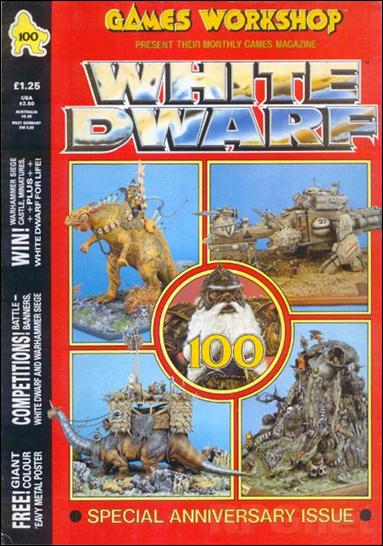
Issue 100 is, largely, a celebration of this past without actually providing much content dealing with traditional roleplaying. However, its does focus on fantasy modelling in a big way, and for the first time, miniatures appear on the front cover. Issue 101 sees the launch of 2nd edition Bloodbowl, with a great deal of pretty pictures and miniatures on show. The changes are increasingly clear by now, with no out of studio material at all, save the soon to be culled classifieds in the back of the magazine. The pattern of Warhammer releases follows its current downwards trend, with only a single advert (the wonderful Elf cavalry below) in 100 but major developments were just around the corner. Issue 101 sees more WFB content and details the iconic release of the Mighty Fortress, Citadel's polystyrene castle and makes reference to the first supplement to WFB3, the complex Warhammer Siege. 

I love the faint allusion to zebra strips on some of the horses, though its left to our imagination of these markings are natural to the breeds of elf horse or have been applied as some kind of warpaint. 
Elven Cavalry 
I much prefer the '80s look of the elves than the overblown po-faced designs of the 21st century. Here we have a series of mounted figures and a few spearmen. The models themselves are well proportioned and varied, with a mix between spear, sword and bow, providing the gamer with an opportunity to field units of each if they so desired. The tall helms and long chainmail coats have a faint middle eastern whiff about them and an effort has been made to sculpt horses that look different than the standard human one. These mounts are smaller and more graceful, much like their riders, though they are limited to two poses. This does effect the overall look of the models when seen together, as the advert above shows, as with skillful painting each horse can be made to look quite different. 
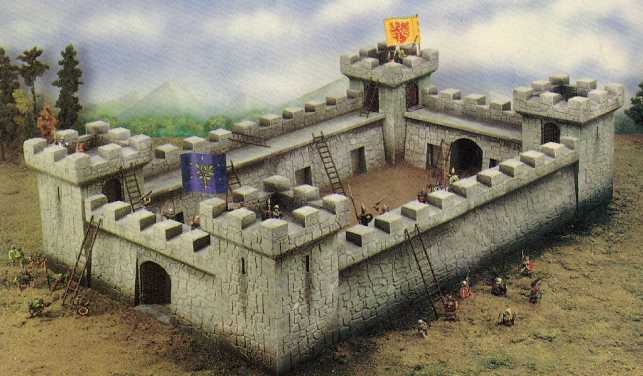
In my book, the Mighty Fortress is one of the greatest '80s releases. 
The Mighty Fortress
I always appreciated the fact that the Mighty Fortress was peddled to us as an accessory for both Warhammer and  Rogue Trader. I loved the idea of Medieval Worlds, where a few aliens could manipulate the masses and take power, only for some off world rivals to arrive and recruit local allies. The mix between RT and WFB rules was always exciting and varied. Best suited for skirmish games, narratives based on this simple premise are brilliant fun and were sadly missing from later editions. 
      So what did you get? A quick glance at the image below can provide more detail than I can express here, but basically, you got four towers, four wall sections and two gateway sections as well as loads of plastic doors, hatches and gateways. I'd always wanted one of these but lacked the funds back in the day, so a decent copy of the castle was one of the first purchases I made after I 'went retro' about two years ago. I remember the enormous package arriving in the back of a Royal Mail van and tearing the brown paper off with great excitement. The castle is very tactile. It feels light but solid and has the polystyrene familiarity that takes you straight back to toys and Christmases of old. Sure, there is better detailing today among plastic and resin castles, but the simple charm of this set compliments '80s models perfectly. The downside is, of course, the fragility of the castle itself. A hefty knock and the straight, even lines are characteristically, for polystyrene, damaged. However, this does make any conversions very simple to achieve.

One of the original adverts for the fortress, showing off the plastic components in a little more detail; ladders, doors, gateways and a flag pole or two. 

Dwarf Gyrocopter 
Zany inventions and crazy ideas were, and are, one of the major attractions for WFB3 era models and rulesets. If someone had a good idea for a model, it was usually made and some rules published alongside the release. The Gyrocopter is a lovely example of this. Sculpted by Mark Copplestone, the model is detailed and fantastic, but shares enough of real design to be believable. Its not a piece I know much about, not having and example in my own collection but I is certainly a model I'd be keen to own at the right price. 


The rules for this model were published in WD101 and are presented to you below along with a bit of background. They were written by Richard Halliwell and illustrated by Pete Knifton. One aspect of the models use in games is the fact that you can use a single model as a mount for a high level character. Fancy putting your dwarf general in one of these? I would if I had one.


So, we have moved from issue 93 to 101 and seen Warhammer: The Game of Fantasy Battles released and seen an abundance of new models, and re-released sculpts appear in the pages of White Dwarf. The game was about to see its first supplement release, Warhammer Siege, which would expand the gameplay of both WFB3 and Rogue Trader, as well as provided a reason for dropping your Mighty Fortress into your games.

We will discuss the book at length in our next discussion of what was 'Acceptable in the '80s.'

Orlygg.